WordPress multisite content migration: an agency guide
How to migrate content on WordPress multisite networks — per-site rebuilds, domain mapping, shared users, and moving subsites into standalone ACF block builds…
verifiedReviewed by Tommy Smith,Content Director

WordPress multisite migrations need site-scoped crawls (mapped domain or subdirectory URL), per-subsite media paths under sites/{id}/, author ID remapping when extracting to standalone installs, and redirect maps that respect domain mapping — not just single-site rules applied network-wide.
WordPress multisite is common in agency portfolios — a network for a franchise, a university department tree, or a holding company with a subsite per brand. When one subsite needs a full rebuild on ACF blocks, or the whole network splits into standalone installs, the migration rules you use on single sites still apply — but the plumbing around users, media URLs, domain mapping and shared themes adds steps that catch teams who've only migrated single sites before.
Know which migration type you're doing
| Scenario | What moves | Complexity |
|---|---|---|
| Single subsite rebuild on the network | One site's content into new blocks; network stays | Medium |
| Subsite to standalone install | Content + media + users to a new single-site WP | High |
| Network consolidation | Multiple subsites into one site or fewer subsites | High |
| Full network replatform | Every subsite rebuilt; shared block library | Very high |
Shared resources that trip people up
Media library
On standard multisite, media may live in a shared uploads folder (sites/site-id/…) or per-site depending on configuration. When you crawl a subsite for migration, image URLs include the site path. Your sideload step must resolve the correct absolute URL for that subsite, not the main network domain. After migrating to a standalone install, every image needs to exist in that install's own uploads — not reference the network path.
Users and authors
Network users can be members of multiple subsites. If you're moving one subsite to a standalone site, decide which authors come across and whether their user IDs will change. Post attribution breaks silently when author IDs don't map. Export a user list with email → new user ID mapping before bulk import.
Domain mapping
Mapped domains (subsite.client.com pointing at site ID 4) mean your crawl URL is the mapped domain, not network.client.com/subsite/. Crawl what Google indexes. Redirect maps must account for the domain change if the subsite is moving to its own domain entirely.
Rebuilding one subsite on ACF blocks (network stays)
- 1Activate or develop the new block theme on that subsite only — network-enable it if other sites will share the library later.
- 2Export ACF field groups from the subsite's active theme (or the shared theme if blocks are network-standardised).
- 3Crawl the subsite's public URLs using its mapped or subdirectory URL.
- 4Import drafts on that subsite's staging environment — subsite staging, not the main network site.
- 5QA within the subsite context: menus, internal links stay within that site's URL space.
- 6Launch on the subsite; network admin and other subsites are unaffected.
Extracting a subsite to a standalone install
This is the heavier path — the subsite leaves the network entirely. Tools like NS Cloner or manual export move tables and files, but content still needs re-mapping if you're rebuilding on ACF blocks at the same time. Typical sequence:
- 1Stand up a fresh single-site WordPress install with the new ACF block theme.
- 2Crawl the subsite on the network (while still live) and migrate content into the new install via bundle import.
- 3Migrate users who need access; reassign post authors.
- 4Sideload all media into the new install's uploads — don't rely on cross-install hotlinking.
- 5Build redirect map from old subsite URLs to new standalone URLs — especially if the domain changes.
- 6DNS cutover: point the domain at the new install; keep network subsite redirects live during transition.
SEO and governance on networks
- arrow_rightEach subsite may have its own Search Console property — submit sitemaps per property after migration.
- arrow_rightNetwork-wide robots.txt may not reflect per-subsite needs; verify after rebuild.
- arrow_rightShared SEO plugins sometimes store network defaults that override subsite settings — check per-site Yoast/Rank Math config.
- arrow_rightCookie consent and analytics may be network-managed; subsite rebuilds can break tracking if GTM containers reference old paths.
Single-site migration fundamentals — redirect maps, internal links, staging workflow — all still apply. Multisite is those same checks with site ID and domain awareness.
Network-wide block libraries
Agencies standardising on one ACF block library across a franchise network should network-activate the theme or mu-plugin registering blocks only after every subsite's content model is compatible. A block library built for subsite A's CPTs may break subsite B's editors. Version ACF JSON in Git; deploy to network in phases with per-subsite crawl-and-map runs.
Worked example: franchise subsite to standalone
A franchise location subsite on site ID 7 uses mapped domain location.client.com with forty UX Builder pages. Extract to standalone WordPress: crawl location.client.com, import ACF block drafts on new install, rsync sites/7/ uploads folder, remap forty authors to three local editors, 301 forty-two URLs from old paths, DNS cutover Friday night. Network subsite left with 301 to new domain for ninety days. Multisite overhead: two extra dev-days vs identical single-site migration.
Network plugins and subsite plugin tables
Multisite plugin activation states differ from single-site installs. Network-activated plugins run on every subsite; subsite-activated plugins store options in per-site tables (wp_2_options, wp_3_options, etc.). When you crawl subsite 4's content, SEO meta and ACF field groups may reference plugin settings stored in that subsite's options table — not the main network site. Export ACF JSON from the subsite where blocks are registered, not from network admin unless the block library is genuinely network-wide.
- arrow_rightConfirm which plugins are network-active vs subsite-active before migration.
- arrow_rightACF field groups: export from the subsite that will receive the import.
- arrow_rightSEO plugin global settings: copy per subsite — network defaults may override unexpectedly.
- arrow_rightCaching plugins on multisite may serve stale crawl output — bypass cache during crawl window.
NS Cloner versus crawl-and-map rebuild
NS Cloner and similar tools copy subsite tables wholesale — fast for lift-and-shift host moves, wrong for ACF block rebuilds. Cloning preserves Elementor meta, UX Builder shortcodes, and every builder artifact you are trying to escape. Use clone when the destination is identical structure on a new host; use crawl-and-map when the subsite rebuilds onto native ACF blocks. Many franchise projects combine both: clone to staging for reference, crawl production for clean import into the new theme.
Subsite table prefixes and database hygiene
WordPress multisite assigns table prefixes by site ID — wp_2_posts, wp_2_postmeta for site 2. Developers exporting meta manually must filter by blog_id. WP-CLI commands need --url=subsite.example.com to target the correct context. Running search-replace on the whole network without blog scoping corrupts unrelated subsites — a mistake that ends careers on large networks.
- 1Use wp site list to confirm site IDs and URLs.
- 2Run wp export --url=mapped-domain.test on the subsite being migrated.
- 3Scope SQL queries with blog_id or correct table prefix.
- 4Test search-replace with --dry-run on subsite tables only.
- 5Back up the entire network before any bulk operation — not just the target subsite.
Franchise and multi-brand governance
Franchise networks share brand guidelines but differ in local content — phone numbers, addresses, team photos, service area copy. A shared ACF block library with localised repeater rows works well; a single crawl of the corporate site does not populate franchise location pages. Plan per-subsite crawls or a spreadsheet-driven local content merge after importing the corporate template bundle.
| Model | Migration pattern | Watch out for |
|---|---|---|
| Corporate template + local pages | Import corporate crawl; manual local overrides | Local NAP data in wrong block fields |
| Identical subsites per region | Same crawl spec; repeat import per subsite | Duplicate content SEO if URLs are public |
| Subsidiary brands leaving network | Extract to standalone — full redirect map | Domain mapping cutover timing |
Multisite staging environments
Staging a single subsite on a multisite network is awkward — network themes, mu-plugins, and shared user tables complicate isolation. Options: clone subsite to a standalone staging install (cleanest for ACF rebuild QA), use a subdomain staging mapped to one site ID, or local development with exported subsite tables. QA internal links within the subsite scope — links pointing at other subsites on the network need explicit decisions when extracting to standalone.
Frequently asked questions
Can I use AIRA to crawl one subsite on a multisite network?expand_more
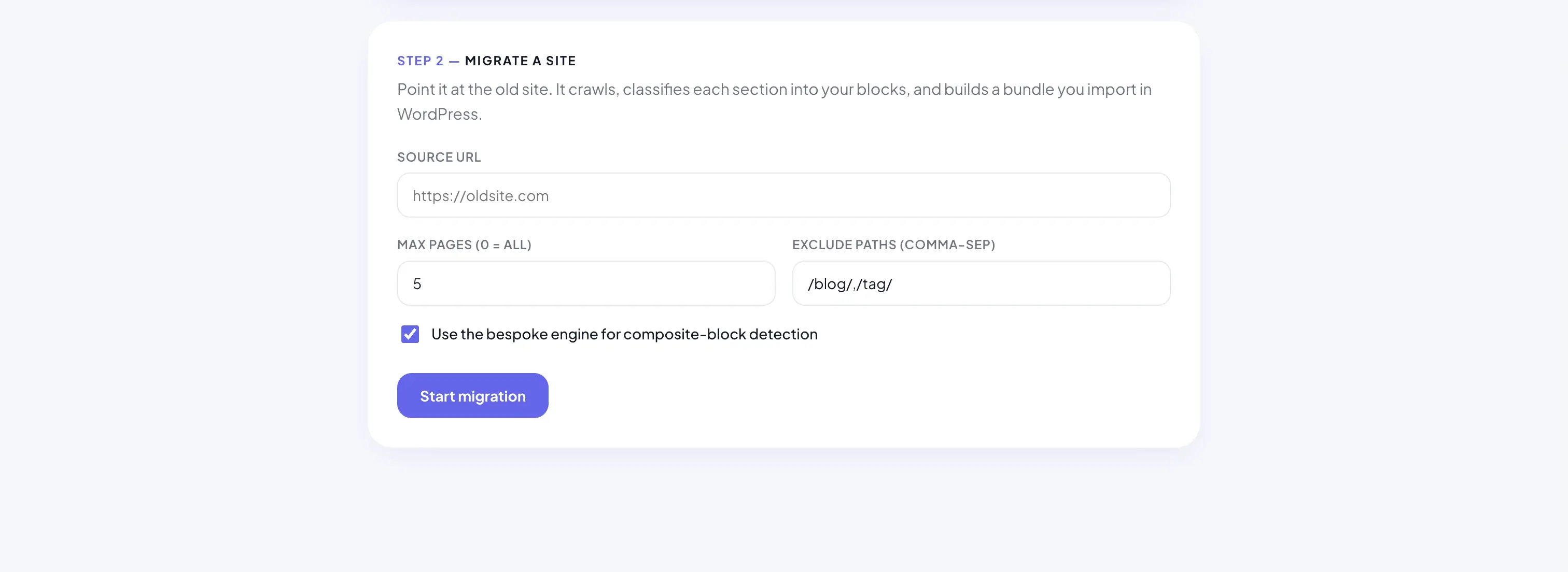
Yes — point the crawler at the subsite's public URL (mapped domain or subdirectory). Include/exclude path filters help scope to that subsite only. The bundle imports into that subsite's WordPress admin via the ACF Migrate plugin.
Will cloning a subsite with NS Cloner preserve page builder content?expand_more
Cloning preserves the database as-is — including UX Builder, Elementor or Flatsome shortcodes. It doesn't convert content to ACF blocks. Clone if you're moving hosts unchanged; crawl and map if you're rebuilding structure.
How do I avoid breaking other subsites during one subsite's rebuild?expand_more
Develop on that subsite's staging clone or a local copy of the subsite tables — never experiment on shared network themes in production unless the block library is tested network-wide. Network-activate new themes only when every intended subsite is ready.
Can I migrate all subsites in one AIRA project?expand_more
Run separate crawl projects per subsite with path or domain filters. Each subsite has different content even when sharing a block library — one spec sheet can serve all subsites if the ACF JSON is identical, but commits and imports are per destination site.
What happens to network users when a subsite goes standalone?expand_more
Users remain on the network unless you export them. Extract only users who need access on the standalone install; map old user IDs to new IDs before publishing posts or author archives break silently.
Do subsite uploads folders merge on standalone extract?expand_more
Copy sites/{id}/uploads/ to the standalone wp-content/uploads/ and run URL search-replace for path changes. Sideloading during AIRA import is cleaner when doing a content rebuild — avoids carrying orphaned attachment records from the network.
How do I handle shared network themes during one subsite rebuild?expand_more
Develop the new block theme on staging clone first. Network-activate only when ready — switching a shared theme on production affects every subsite using it. Use a subsite-specific theme assignment if the network allows per-subsite themes.
Is multisite migration harder than single-site?expand_more
Site-scoped content migration is similar once you crawl the correct URL. Complexity comes from shared resources — users, media paths, domain mapping, network plugins — which add two to four dev-days on extract-to-standalone projects versus an equivalent single-site rebuild.

Ryan Hale
Head of Front End Development
Ryan Hale is Head of Front End Development at AIRA, where he leads the team building the engine that migrates WordPress sites into native ACF blocks. He has spent more than a decade building and rebuilding WordPress sites for agencies, with deep, hands-on expertise in Advanced Custom Fields, Gutenberg block development, and large-scale content migrations that protect search rankings. He writes about ACF, moving off page builders like Elementor and Divi, and the practical craft of shipping fast, maintainable WordPress rebuilds.
Reviewed to our editorial guidelines.