Migrating from Breakdance to ACF blocks
Leaving Breakdance for ACF blocks? How Breakdance stores content, why agencies standardise on ACF, element mapping, and the full migration workflow for native…
verifiedReviewed by Tommy Smith,Content Director
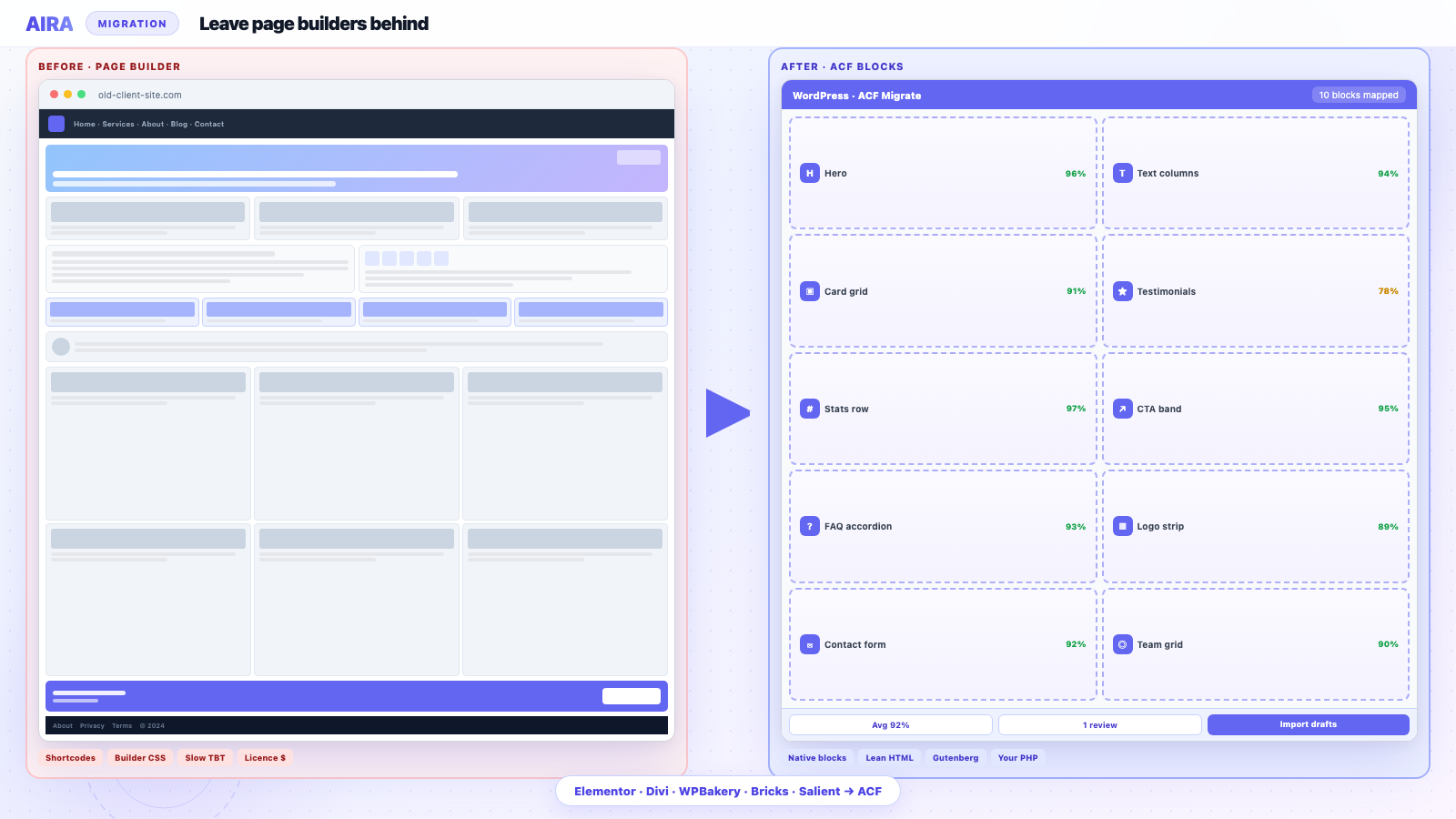
Breakdance stores layout in post meta JSON, not portable Gutenberg blocks. Crawl rendered pages while Breakdance is active, map elements to your ACF library, rebuild templates separately, and import as drafts.
Breakdance Builder earned a following by being what many wished Elementor had been: fast output, sensible DOM, and a builder that developers do not hate. Agencies do not always leave Breakdance because it is slow — they leave because portfolio consistency matters. One ACF block library, one editor experience, one migration spec that reads an ACF JSON export. When that standardisation decision lands, Breakdance sites are still a full content migration, not a plugin toggle.
Why agencies leave Breakdance
- arrow_rightPortfolio standardisation: one block library across Elementor, Divi, Breakdance, and Bricks clients.
- arrow_rightEditor handover: content teams trained on ACF fields, not builder-specific UI.
- arrow_rightClient ownership: no Breakdance licence dependency on every site.
- arrow_rightMigration tooling: ACF JSON export is the mapping contract — Breakdance JSON is not.
- arrow_rightLong-term support: fewer builder-specific bugs and update compatibility issues.
How Breakdance stores content
- arrow_rightPage structure saved as JSON in post meta — not portable Gutenberg blocks in post_content.
- arrow_rightGlobal blocks and templates in Breakdance's template system — headers, footers, popups.
- arrow_rightDynamic data elements (post loops, ACF dynamic fields) tied to Breakdance's runtime.
- arrow_rightClean front-end HTML — often higher classifier confidence than Elementor or Divi.
Breakdance elements to ACF blocks
| Breakdance element | ACF block target | Notes |
|---|---|---|
| Section / Div | Skip wrapper | Map children only |
| Heading / Text | Hero or text block | Preserve H1–H6 level |
| Image / Gallery | Hero or gallery block | Sideload; check srcset |
| Icon Box / Icon List | Features repeater | One row per item |
| Testimonial | Testimonial repeater | Avatar + quote + name |
| Posts Loop | Dynamic grid block | WP_Query on new theme |
| Form | Rebuild in Gravity/WPForms | Do not migrate handler blindly |
| Accordion / Tabs | FAQ or tabs block | Repeater per panel |
| Pricing Table | Pricing repeater block | One row per tier |
Templates and global blocks
Breakdance headers, footers and popup templates will not land in a page-body import. Rebuild them as theme template parts before removing the plugin. Popup triggers especially will not appear in a standard page crawl — inventory them in the Breakdance admin and recreate essential ones in your theme or a lightweight popup plugin.
Template inventory checklist
- 1List all Breakdance templates: header, footer, single, archive, 404.
- 2Note popup rules and triggers — which pages, which conditions.
- 3Identify global blocks embedded across multiple pages.
- 4Document dynamic elements: post loops, ACF dynamic tags, WooCommerce hooks.
- 5Plan theme template parts for each before page import.
Migration workflow
- 1Inventory Breakdance templates and pages; export sitemap.
- 2Register ACF block library; export field groups as JSON.
- 3Crawl live pages while Breakdance is active.
- 4Classify sections; flag post loops and forms for dev review.
- 5Import drafts; rebuild header/footer templates on new theme.
- 6Run QA checklist and shortcode sweep.
- 7Launch with SEO preservation and redirects.
Breakdance vs other builders
Cleaner HTML than Elementor or Divi often means higher mapping confidence and less junk to drop in review. The workflow is the same as Bricks — crawl, map, import — with extra attention to Breakdance global blocks and popups.
Common mistakes
- arrow_rightAssuming Breakdance export JSON works for ACF import — it only moves between Breakdance installs.
- arrow_rightForgetting popups and global blocks — they are invisible to page crawls.
- arrow_rightDeactivating Breakdance before crawl completes.
- arrow_rightNot flagging post loops — classifier may static-map dynamic grids.
- arrow_rightMigrating forms without rebuilding handlers — submissions go nowhere.
- arrow_rightTreating Breakdance migration as easier and skipping review — forms and loops still need human eyes.
- arrow_rightNo fallback text block in spec — edge-case sections get dropped.
AIRA crawls Breakdance pages with typically higher confidence than Elementor sources. Agencies standardising block libraries use the same ACF JSON spec across builder types.
When Breakdance migration makes business sense
The business case for leaving a performing Breakdance site is portfolio economics, not performance. When your agency manages twelve clients on four different builders, every support ticket requires builder-specific knowledge. Standardising on ACF blocks means one editor training doc, one block library Git repo, one migration spec, and one QA checklist. The migration cost is a one-time investment against years of reduced support overhead.
Handling Breakdance dynamic elements
Breakdance post loops, ACF dynamic tags, and WooCommerce elements render dynamically on the front end. The classifier sees the rendered output — a grid of six posts, for example — but cannot know the query behind it. Document each dynamic element during inventory: what post type, what filter, what count, what ordering. Rebuild the query in your ACF block template using WP_Query with the same parameters.
Performance note
Breakdance produces cleaner HTML than Elementor or Divi, so performance may already be acceptable. If the client is happy with speed, frame the migration around editor handover and portfolio consistency rather than PageSpeed scores. If performance is part of the pitch, benchmark anyway — the improvement may be smaller than builder-to-ACF migrations on heavier builders.
Post-migration cleanup
- 1Deactivate Breakdance on staging — confirm all pages render.
- 2Rebuild header, footer, and popup templates on new theme.
- 3Verify forms submit correctly with new handlers.
- 4Check dynamic grids pull correct post counts.
- 5Remove Breakdance plugin and licence from production after cutover.
Breakdance global blocks inventory
Breakdance global blocks are reusable sections synced across pages — a promotional banner, a trust badge strip, a seasonal CTA. They appear on rendered pages and will be classified like any other section. But if you update a global block in Breakdance after the crawl, imported pages will not reflect the update. Crawl late in the project — after the client has signed off final content on the old site. Document which global blocks exist and which pages use them.
Comparing Breakdance to Bricks migration
Breakdance and Bricks attract similar developer audiences — people who want builder speed without Elementor bloat. Both store JSON in post meta. Both produce relatively clean front-end HTML. Migration workflow is identical. Breakdance has more global template features; Bricks has tighter theme integration. The element mapping tables differ slightly but the crawl-map-import pattern is the same.
Client conversation for Breakdance exits
Breakdance clients often chose the builder deliberately — they like the interface and the output. The pitch is not 'Breakdance is bad.' The pitch is: one editor experience across all your sites, content your team can maintain without builder-specific training, no Breakdance renewal, and a block library you own. Show the migrated homepage in Gutenberg with labelled ACF fields. Developers who liked Breakdance often appreciate the clean PHP templates on the other side.
Breakdance migration timeline
| Phase | Typical duration (30-page site) | Owner |
|---|---|---|
| Block library development | 2–3 days | Developer |
| Crawl and classification | 2–4 hours | Migration tool + review |
| Bundle import and page QA | 1–2 days | Developer + editor |
| Template rebuild (header/footer/popups) | 1–2 days | Developer |
| Redirect and SEO setup | 0.5 day | Developer |
Standardising after Breakdance
The long-term win is portfolio consistency. Replace Breakdance on this client, then use the same ACF block library on the next Elementor exit. One JSON export, one importer workflow, one editor training deck. Agencies that standardise see migration costs drop with each subsequent project because block development is already done.
Breakdance forms and integrations
Breakdance includes native form elements and integrations with Mailchimp, ActiveCampaign, and webhooks. These do not migrate as ACF field values. Rebuild forms in Gravity Forms or WPForms, reconnect integrations, and test submission flows on staging before cutover. A migrated CTA block with the old form shortcode is a silent failure — the button renders but nothing submits.
Pre-migration Breakdance checklist
- 1Export sitemap; list all Breakdance-built pages.
- 2Inventory global blocks, templates, and popups.
- 3Document dynamic loops and form placements.
- 4Register ACF blocks; export JSON.
- 5Crawl while Breakdance is active.
- 6Plan header/footer rebuild before plugin removal.
Review priorities for Breakdance pages
Breakdance pages often classify well, but four areas need manual verification regardless of confidence score: accordion and tab panels (repeater row count), icon lists (one row per item), post loops (query parameters), and forms (handler rebuilt). Start review with those section types across the homepage and top landing pages. Inner text-heavy pages are usually publishable after a quick visual check.
SEO during Breakdance exit
Breakdance sites often already score better than Elementor on Core Web Vitals — do not oversell performance as the primary reason for leaving. SEO preservation still matters: carry over metadata, set up redirects for slug changes, and monitor Search Console after launch. See rebuild without losing SEO for the full checklist.
Breakdance-to-ACF is a growing segment as agencies standardise block libraries. The cleaner DOM helps classification; the global template inventory is the main extra work. Budget template rebuild time separately from page-body migration and the project stays on schedule.
Handover documentation for Breakdance clients
Include in the handover pack: which pages migrated via bundle import, which templates were rebuilt manually, where forms were recreated, and how to edit each ACF block type. Breakdance clients are often technical — they appreciate knowing exactly what changed and what the new editing workflow looks like in Gutenberg.
Start every Breakdance migration with a template inventory before the page crawl. Headers, footers, and popups are the gaps page-body imports do not cover — catching them in discovery avoids launch-week template emergencies.
The import bundle guide applies identically to Breakdance sources once your crawl and review are complete. The builder changes; the WordPress import step does not. Plan template rebuilds in parallel with bundle review to save calendar time. Most Breakdance page content imports in a single afternoon on staging once blocks are registered and the bundle has been reviewed.
Breakdance migration is not harder than Elementor — it is different. Global templates and popups are the variables, not DOM depth.
What to read next on this rebuild
Breakdance stores JSON layout like Elementor — crawl rendered pages, not raw postmeta. If the site uses Breakdance loops for CPT archives, combine this guide with CPT migration. Compare effort vs Bricks and Oxygen exits when scoping similar rebuilds.
Frequently asked questions
Is Breakdance migration easier than Elementor?expand_more
Often yes — fewer wrapper elements and cleaner DOM mean better section classification. Forms, dynamic loops and template parts still need manual work on any builder.
Can I export Breakdance templates to ACF?expand_more
Breakdance export moves JSON between Breakdance installs. It does not produce ACF field values or native Gutenberg block markup. Section-level mapping from the rendered page is the path.
Should every Breakdance site move to ACF?expand_more
Only when portfolio consistency, editor handover, or shared block libraries justify it. A Breakdance site that performs well with a happy client does not need migration for its own sake.
What happens to Breakdance headers on migration?expand_more
Headers are template-level, not page content. Rebuild as a PHP template part on the new theme. Inventory the Breakdance header template before deactivating the plugin.
How do I migrate Breakdance popups?expand_more
Popups do not appear in page crawls. Inventory popup rules in Breakdance admin and recreate essential ones in your theme or a lightweight popup plugin. Many clients drop non-essential popups on rebuild.
Does Breakdance use shortcodes?expand_more
No — Breakdance stores JSON in post meta and renders at runtime. The front-end HTML is clean, but it is not stored as Gutenberg blocks. You still need classification mapping to ACF.
Can Breakdance dynamic data elements migrate automatically?expand_more
Post loops and dynamic tags need manual planning. The classifier may map the visual grid, but the query logic must be rebuilt in your ACF block template or archive template.
What confidence scores are typical for Breakdance?expand_more
Often higher than Elementor or Divi — typically 85–95% on standard sections. Review post loops, forms, and tabbed content manually regardless of score.
How long does a Breakdance migration take?expand_more
Similar to other builder migrations: one to three days for a 30–50 page site after block development. Template and popup rebuild adds separate dev time.
Do I need ACF Pro for the destination site?expand_more
Yes. ACF blocks require ACF Pro. Register your block library, export JSON, and confirm blocks appear in the inserter before importing the bundle.

Ryan Hale
Head of Front End Development
Ryan Hale is Head of Front End Development at AIRA, where he leads the team building the engine that migrates WordPress sites into native ACF blocks. He has spent more than a decade building and rebuilding WordPress sites for agencies, with deep, hands-on expertise in Advanced Custom Fields, Gutenberg block development, and large-scale content migrations that protect search rankings. He writes about ACF, moving off page builders like Elementor and Divi, and the practical craft of shipping fast, maintainable WordPress rebuilds.
Reviewed to our editorial guidelines.