Migrating from the Salient theme to ACF blocks
Salient uses WPBakery and nectar_* shortcodes. Full playbook for migrating Salient client sites to ACF blocks — Nectar Slider, portfolio CPT, and common…
verifiedReviewed by Tommy Smith,Content Director
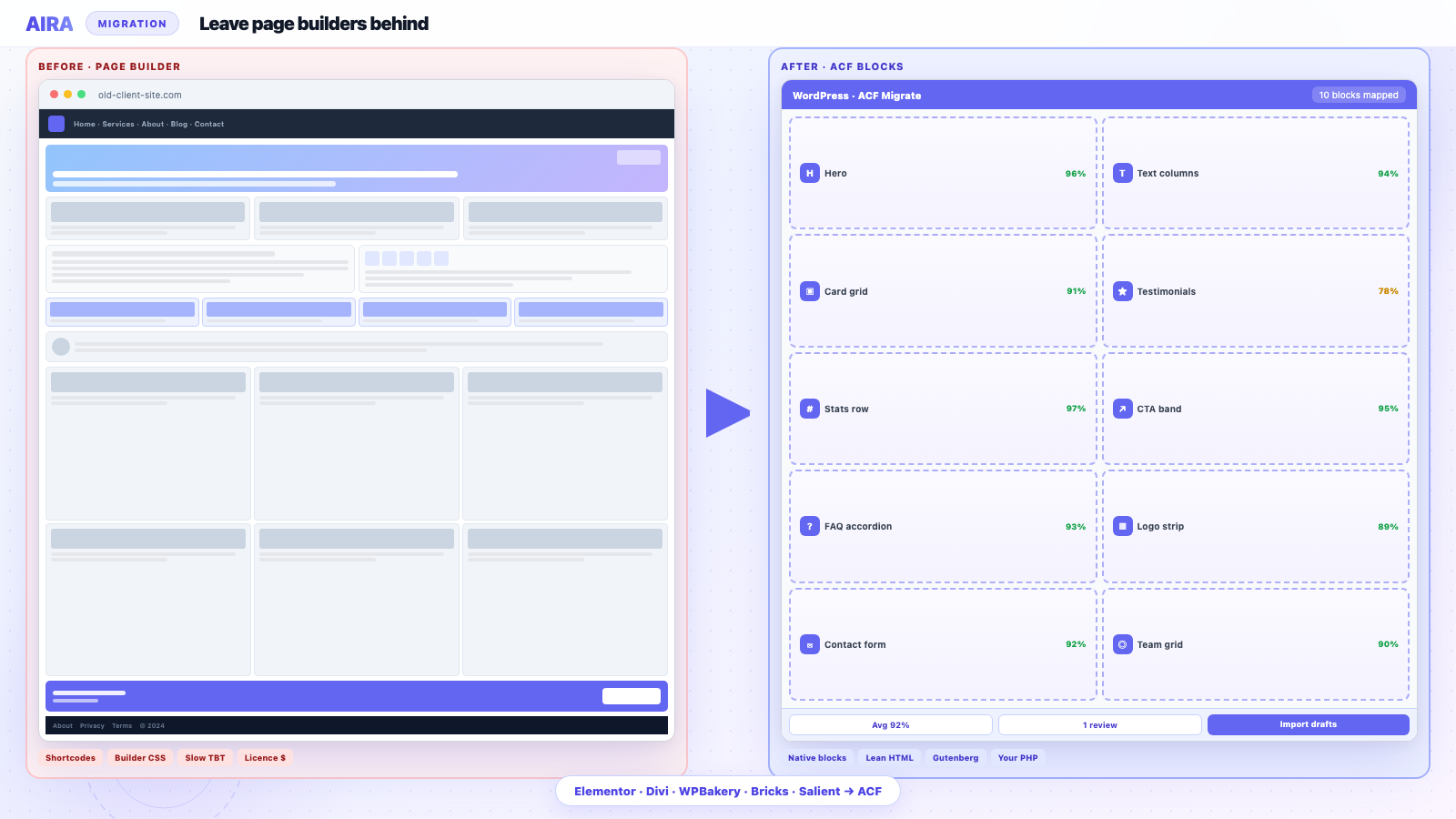
Salient combines WPBakery shortcodes with theme-specific nectar_* elements. Crawl rendered pages, map sliders and portfolio grids to ACF blocks, migrate the portfolio CPT if needed, and budget extra review time on demo-import homepages.
Salient is a premium theme that has been popular with creative agencies for years — bold portfolios, Nectar Slider heroes, and WPBakery (Visual Composer) under the hood. Inheriting a Salient client site for a rebrand means facing two layers of lock-in: WPBakery shortcodes and Salient-specific elements like nectar_slider, nectar_highlighted_text and portfolio grids. You cannot swap the theme and keep the site. You crawl, map, and rebuild.
Why Salient migrations are harder than average
A standalone WPBakery site has one shortcode dialect. Salient adds a second — nectar_* elements that only render with Salient active. Deactivate the theme and you lose both layers. Demo-imported Salient sites are especially dense: homepages with 30+ shortcode elements are common. Budget disproportionate review time on the homepage, portfolio index, and any page using Nectar Slider.
Salient's content layers
- arrow_rightWPBakery shortcodes: [vc_row], [vc_column_text] — same class of problem as standalone WPBakery.
- arrow_rightSalient shortcodes: nectar_slider, nectar_portfolio, nectar_btn, nectar_icon — theme-specific, vanish without Salient.
- arrow_rightNectar Slider: often the homepage hero — stored as shortcode or theme meta.
- arrow_rightPortfolio post type: Salient's portfolio items may need mapping to your case-study structure.
- arrow_rightTheme options: colours, fonts and header layouts in Redux — do not migrate; rebuild in your theme.
Element mapping reference
| Salient / VC element | ACF block target | Notes |
|---|---|---|
| nectar_slider | Hero slider block | One repeater row per slide |
| nectar_portfolio | Case studies grid | May need CPT migration |
| nectar_highlighted_text | Text block with styled span | Simplify to theme typography |
| nectar_btn | CTA block | Link + label |
| nectar_team_member | Team block | Repeater per person |
| vc_gallery | Gallery block | Sideload all images |
| nectar_blog | Posts grid or archive template | Dynamic query on new theme |
| nectar_icon | Features block | Icon + heading + text per row |
| fullscreen_rows | Hero block | Poster image + video URL separately |
Nectar Slider migration
Nectar Slider is the Salient-specific variable most migrations underestimate. Each slide needs image, heading, caption, and link extracted into your hero slider ACF block repeater. Migrate from the rendered slider on the live site — not shortcode attributes in the backend editor. A common failure: the classifier collapses eight slides into a single static hero image because the slider block repeater was not defined with enough rows in the field group.
Portfolio and blog considerations
Salient's portfolio custom post type does not automatically become your new case-study structure. Decide early: migrate portfolio items to a new CPT, fold them into standard pages, or retire unused projects. Portfolio URLs often have backlinks from awards sites and press features — if slugs change from /portfolio/project-name/ to /work/project-name/, every old URL needs a 301. Blog posts are often standard WordPress posts — lower migration cost unless WPBakery was used in the post body.
Portfolio CPT decision matrix
| Option | When to use | Redirect needed? |
|---|---|---|
| New case-study CPT | Client actively maintains portfolio | Yes, if slug structure changes |
| Standard pages | Small portfolio, rarely updated | check_circle |
| Retire unused projects | Outdated work, no traffic | 301 to portfolio index or 410 |
| Keep archive template only | Portfolio is decorative | Minimal |
Step-by-step workflow
- 1Crawl sitemap; tag portfolio, blog, and WPBakery-built pages.
- 2Register ACF blocks including hero slider and case-study grid.
- 3Export field groups as JSON — upload to migration tool.
- 4Crawl rendered pages — not Salient backend editor.
- 5Map nectar_* and vc_* sections to blocks; manual review on sliders.
- 6Migrate portfolio CPT if retaining case studies.
- 7Import drafts; QA checklist; shortcode sweep on staging.
- 8Load redirects and preserve SEO metadata.
- 9Deactivate Salient on staging; confirm no raw shortcodes remain.
Pre-migration checklist
- 1Inventory all nectar_* shortcode types used across the site (regex search in database or crawl).
- 2Screenshot Nectar Slider and portfolio index for design QA reference.
- 3Define new portfolio URL structure and redirect map.
- 4Rebuild megamenu and menu icons in new theme nav — not page content.
- 5List Salient theme options to recreate (header layout, transparent nav, footer columns).
- 6Confirm ACF block library on staging matches production field keys.
Salient-specific pitfalls
- arrow_rightnectar_slider shortcode with 8 slides collapsed into a single-image hero — extend your slider block repeater first.
- arrow_rightAnimated text (nectar_highlighted_text) lost because the new theme has no equivalent — simplify to bold or a design token.
- arrow_rightFullscreen rows with video backgrounds — migrate poster image and video URL separately into your hero block.
- arrow_rightSalient menu icons and megamenu — rebuild in new theme nav walker, not as page content.
- arrow_rightnectar_portfolio grid pulling wrong post count — verify query args on new case-study block.
- arrow_rightWPBakery nested rows inside Salient sections — classifier may merge columns; review manually.
- arrow_rightSalient box roll and parallax effects — cosmetic only; do not try to replicate in migration.
SEO and performance
Salient sites often score poorly on mobile Lighthouse due to slider JS, parallax scripts, and WPBakery CSS. Rebuilding on ACF blocks removes that overhead. Preserve titles, meta descriptions, and heading structure through the migration — integrate Yoast on the new build. Full guidance in rebuild without losing SEO.
Salient sits closest to Avada and WPBakery migrations — shortcode-heavy theme plus builder combo. Nectar Slider is the Salient-specific variable. AIRA crawls rendered Salient pages and maps sections into your ACF block library.
Handling Salient demo-import bloat
Many Salient sites started from a ThemeNectar demo import — photography studio, creative agency, tech startup. Demo homepages pack in every nectar_* element the theme offers: slider, portfolio grid, team row, testimonial carousel, client logo strip, blog feed, and multiple CTA bands. The classifier handles each section individually, but review time scales with section count. For demo-import homepages, allocate a full day of QA. Consider whether every section is still needed — clients often welcome a simpler homepage on rebuild.
Salient and WooCommerce
Salient includes WooCommerce styling and shop templates. Product pages built with WPBakery inside Salient need the same crawl approach as standard pages. Salient's shop archive templates are theme-level — rebuild on your new theme's WooCommerce templates. Cart and checkout pages should use WooCommerce defaults or your new theme's templates, not migrated shortcode content.
Post-migration verification
- 1Deactivate Salient on staging — every migrated page should still render.
- 2Database search for [vc_ and [nectar_ shortcodes — zero in migrated content.
- 3Portfolio CPT URLs redirect correctly if slug structure changed.
- 4Nectar Slider pages render with correct slide count in hero repeater.
- 5Megamenu and mobile nav function on new theme.
- 6Run shortcode cleanup sweep across all post types.
Timeline and resourcing
A typical Salient migration for a 30-page creative agency site: two to three days block development, one day crawl and classification, two days review and QA, one day portfolio CPT migration if applicable, one day redirect and SEO setup. Demo-import homepages and large portfolios add a day each. Quote accordingly — Salient is never a quick theme swap.
Salient vs Avada vs standalone WPBakery
Salient, Avada, and standalone WPBakery sites share the shortcode problem but differ in theme-specific elements. Salient has nectar_* shortcodes and Nectar Slider. Avada has Fusion Builder elements. Standalone WPBakery has only vc_* shortcodes. Migration workflow is identical — crawl, map, import — but your element mapping table changes. Salient's double layer (WPBakery + nectar) means more review time than standalone WPBakery.
Redux theme options
Salient stores colours, fonts, button styles, header configurations, and footer layouts in Redux theme options. None of this migrates to ACF blocks — it is presentation config, not page content. Document the current Salient options as a reference for your new theme's design tokens. The client may ask why the old accent colour is gone — because it lived in theme options, not in editable page content.
Training editors after Salient
Salient editors are used to WPBakery's backend builder and Nectar's visual controls. Gutenberg with ACF sidebar fields feels different. Run a hands-on session using the migrated homepage draft: show how to edit a hero slider repeater, add a team member row, swap a gallery image. Salient-trained editors who understand repeaters adapt within a week. Editors who only ever clicked in the visual builder need more support in the first month.
AIRA workflow for Salient sites
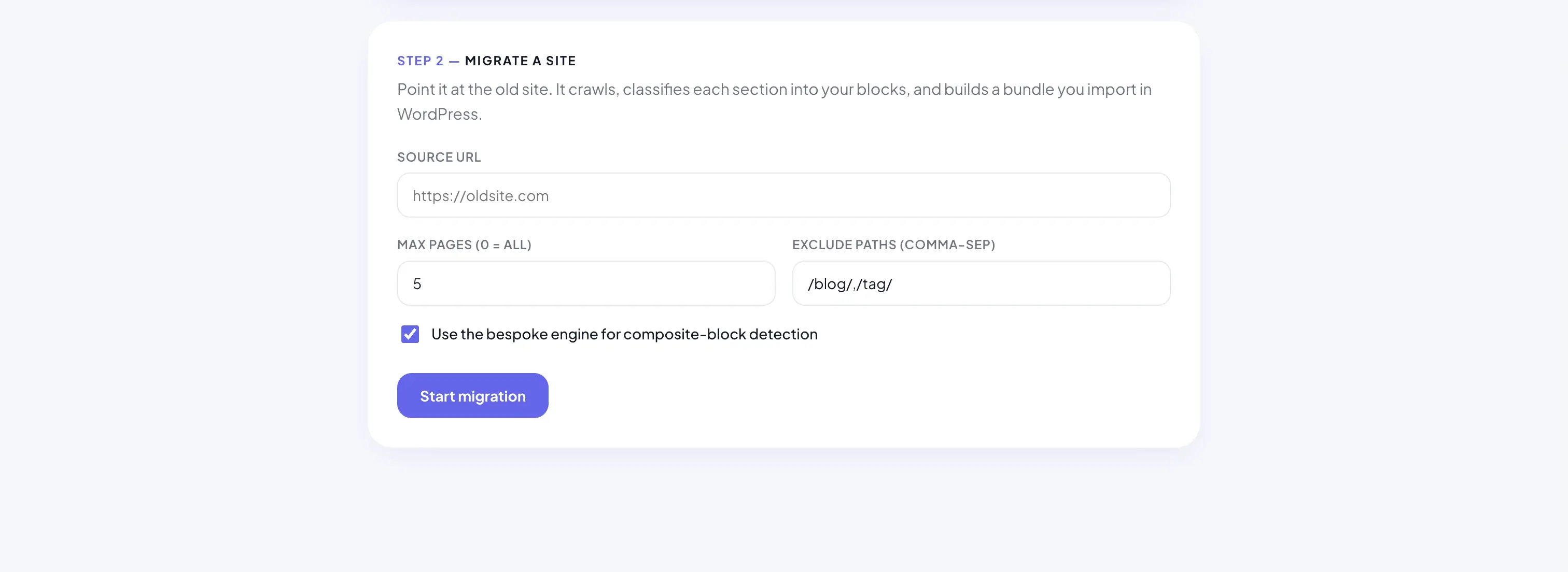
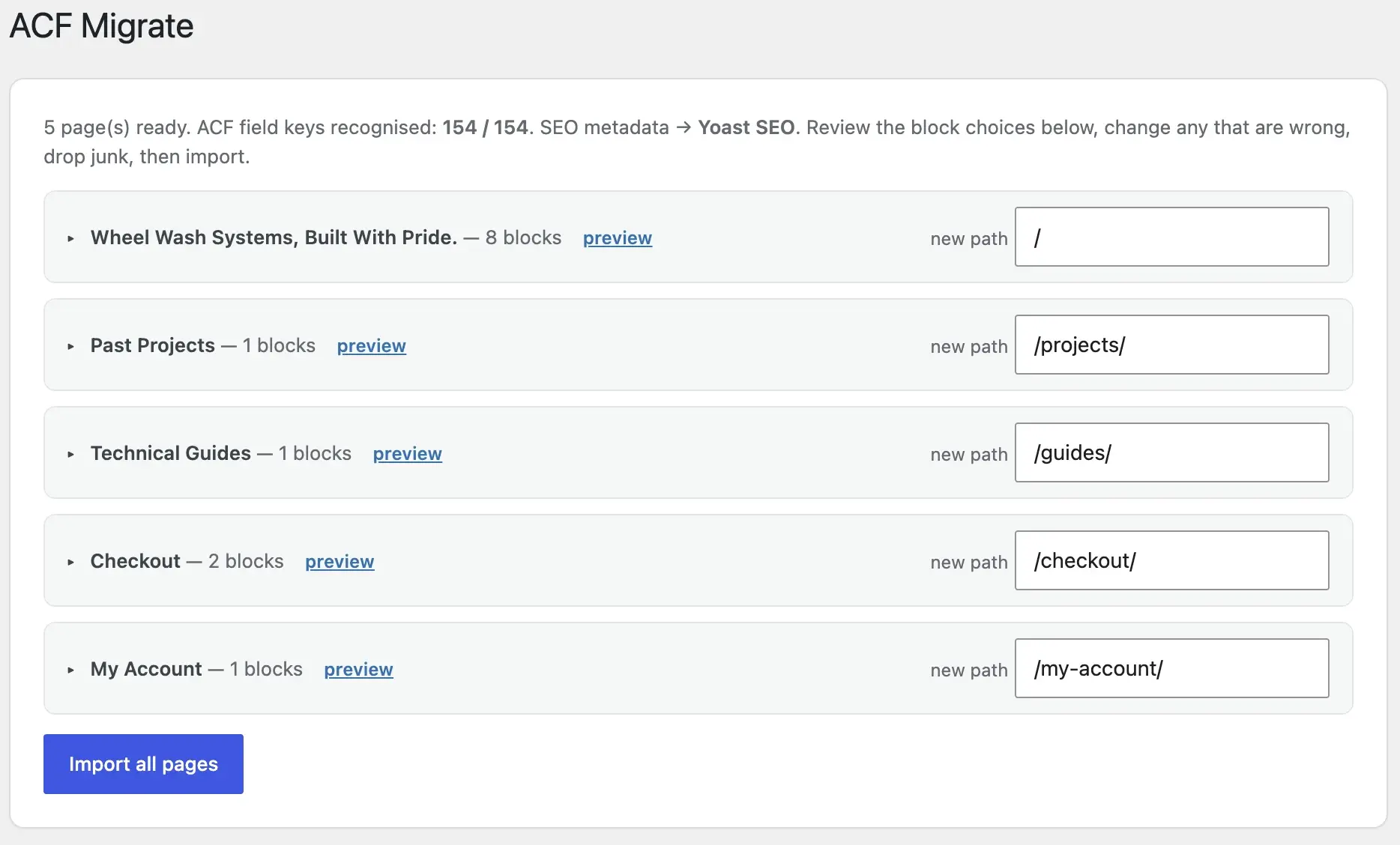
Register your block library including hero slider and case-study grid. Export ACF JSON. Crawl the Salient site while the theme is active. Review nectar_slider and nectar_portfolio classifications carefully — these are the highest-risk sections. Import as drafts, rebuild megamenu on the new theme, migrate portfolio CPT if retaining case studies, then run migration QA before deactivating Salient.
Salient migration pricing factors
- arrow_rightPage count and section density — demo-import homepages cost more to review.
- arrow_rightPortfolio CPT migration — separate from page-body import.
- arrow_rightMultilingual — crawl per language.
- arrow_rightCustom nectar elements — may need bespoke ACF blocks.
- arrow_rightMegamenu rebuild — dev time, not migration tool time.
- arrow_rightBlock library development if not already standardised.
After Salient: long-term maintenance
Once off Salient, the client no longer depends on ThemeNectar updates, WPBakery compatibility, or nectar_* shortcode rendering. Support shifts to your theme and ACF block library — code you control. Document the block library for the client. Include a one-page 'how to edit your homepage' guide. Salient exits are front-loaded with migration effort; the ongoing cost is lower than staying on a theme-plus-builder stack you do not own.
If you are scoping a Salient exit now, start with a sitemap crawl and a homepage section count. That single page tells you how dense the rest of the site likely is and whether the project fits a fixed-price migration or needs time-and-materials review.
Salient creative portfolios are worth the migration effort. These sites often have strong backlinks, award features, and brand equity tied to case-study URLs. A careful crawl-and-map approach preserves that equity while moving the client onto a stack you can support for years.
Use AIRA to crawl rendered Salient pages while the theme remains active. Upload your ACF JSON, review nectar_slider classifications on the homepage first, then import the bundle and complete portfolio redirect mapping before deactivating Salient on staging. That sequence prevents the blank-page surprises that happen when shortcode themes are switched off too early.
Salient migrations fail when teams treat them like a theme switch. They are a double-layer shortcode extraction job — plan accordingly.
What to read next on this rebuild
Salient portfolio CPTs and UX-style grids are the reason many Salient rebuilds run long — page migration alone leaves case studies behind. The CPT migration guide is essential for /work/ URLs. Salient and Flatsome share the same WooCommerce + builder shortcode pattern; steal QA steps from both if you maintain a shared agency playbook.
Frequently asked questions
Can I keep Salient and only rebuild the design in theme options?expand_more
Theme options change colours and fonts — not the underlying WPBakery shortcode structure. A visual rebrand on Salient still leaves you in shortcodes. A proper rebuild moves content into ACF blocks on a new theme.
What happens to Nectar Slider on migration?expand_more
Each slide becomes a row in your hero slider ACF block repeater — image, heading, caption, link. Migrate from the rendered slider on the live site, not the shortcode attributes in the editor.
Do Salient portfolio URLs need redirects?expand_more
If portfolio slug structure changes (/portfolio/project-name/ vs /work/project-name/), yes — add every old portfolio URL to your redirect map. Portfolio pages often have backlinks from case-study features and awards sites.
How is Salient different from plain WPBakery migration?expand_more
Salient adds nectar_* shortcodes, Nectar Slider, portfolio CPT, and theme-specific layout options on top of WPBakery. You face two shortcode systems, not one.
Can I export Salient demo content to ACF?expand_more
Salient demo import installs pages full of shortcodes. There is no export path to ACF field values. Crawl the rendered demo pages and classify sections into your blocks.
What about Salient megamenus?expand_more
Megamenus are theme navigation features, not page content. Rebuild in your new theme's menu system. Do not try to migrate megamenu HTML as page blocks.
How long does a Salient migration take?expand_more
A typical 25–40 page Salient site with portfolio takes two to four days for mapping and review after block development. Demo-import homepages alone can take half a day of QA.
Should I migrate Salient blog posts?expand_more
If posts use WPBakery in the body, yes — same crawl approach. Standard posts without shortcodes can use WXR import. Check each post template.
What ACF blocks do I need for Salient?expand_more
At minimum: hero slider, text, card grid, case-study grid, team repeater, gallery, CTA, FAQ, and logo strip. Register these before crawling.
Will animated nectar_highlighted_text survive?expand_more
Usually no — and that is fine. Replace with theme typography (bold, accent colour, or a design token). Clients rarely notice if the new design handles emphasis cleanly.
Can agencies batch Salient migrations?expand_more
Yes, with a standardised ACF block library. Salient-specific mapping rules (nectar_slider → hero slider) apply across clients. See our agency workflow for portfolio scaling.

Ryan Hale
Head of Front End Development
Ryan Hale is Head of Front End Development at AIRA, where he leads the team building the engine that migrates WordPress sites into native ACF blocks. He has spent more than a decade building and rebuilding WordPress sites for agencies, with deep, hands-on expertise in Advanced Custom Fields, Gutenberg block development, and large-scale content migrations that protect search rankings. He writes about ACF, moving off page builders like Elementor and Divi, and the practical craft of shipping fast, maintainable WordPress rebuilds.
Reviewed to our editorial guidelines.