How to migrate from Squarespace to WordPress (into ACF blocks)
A practical guide to migrating Squarespace to WordPress and native ACF blocks — what Squarespace's export does and doesn't include, the gaps to plan for, and…
verifiedReviewed by Tommy Smith,Content Director
Squarespace's built-in WordPress export only covers basic pages and blog posts — not most layouts, style, or content blocks, and not every page type. For a real migration, build your ACF blocks and migrate from the rendered site so each section maps to a block, then 301-redirect Squarespace's URLs to your new structure.
Squarespace-to-WordPress is a migration with a trap built into it: Squarespace does offer an export, so teams assume it's a solved problem and scope the job as a quick import. Then they discover how little that export actually contains. Squarespace is a closed, hosted platform like Wix, and while it's more generous than Wix on export, the file you get is only a slice of your site. This guide explains exactly what transfers, what doesn't, and how to run a Squarespace migration that lands in clean, native ACF blocks rather than a pile of broken shortcodes.
Why teams move from Squarespace to WordPress
- arrow_rightOwnership and portability — get off a closed platform and onto a site you can host anywhere.
- arrow_rightSEO and technical control — full control of URLs, redirects, schema, and performance.
- arrow_rightExtensibility — custom post types, ACF content models, and a plugin ecosystem Squarespace can't match.
- arrow_rightCost at scale — for agencies running many client sites, WordPress on a reusable block library is far more economical.
What Squarespace's WordPress export actually includes
Squarespace has a built-in export (Settings → Import / Export) that produces a WordPress-compatible WXR file. It's genuinely useful — but it's limited, and knowing the limits up front is what keeps the project on budget.
| Content | In the export? |
|---|---|
| Basic pages and text | Partly — one page's worth, with limits |
| Blog posts | check_circle |
| Images | Partly — many, but not always all |
| Galleries, product pages, events, albums | cancel |
| Layout, sections and styling | cancel |
| Index pages / complex page types | cancel |
Crucially, the export carries content as generic blocks, not your design — none of your section layout, styling, or structure comes across. So even when the export works, you land a wall of unstyled content that still has to be rebuilt into your WordPress block structure by hand. That's the same problem you'd have with a raw page-to-page copy: the words arrive, the structure doesn't.
The better approach: migrate from the rendered site
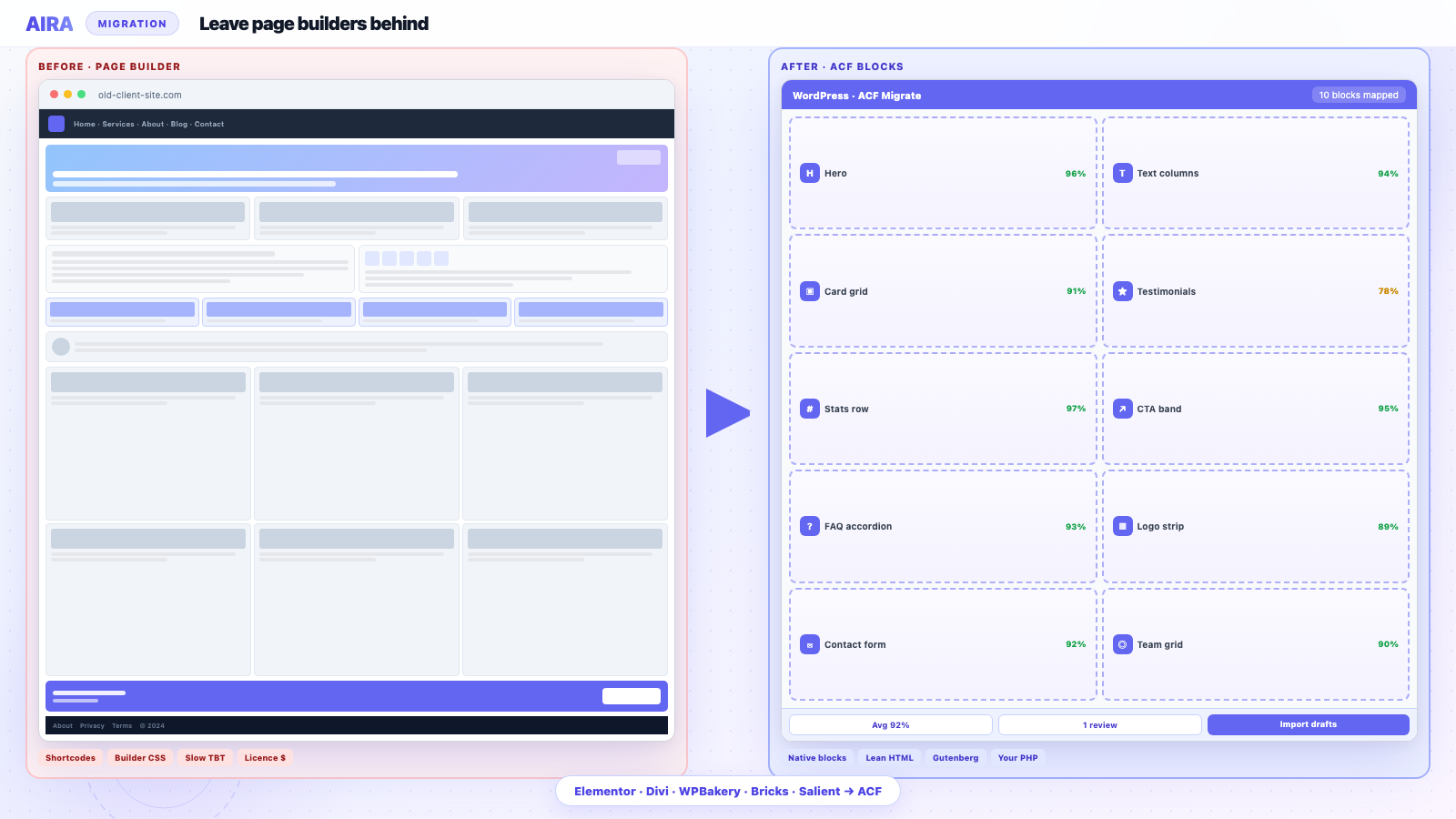
Because the export is partial and structureless, the cleaner route — especially for design-led Squarespace sites — is the same "any site" approach used for Wix and Webflow: read the live, rendered site and classify each section into your ACF blocks. Instead of importing a flat WXR and rebuilding every layout manually, you map the hero to your hero block, the testimonial band to your testimonial block, the gallery to your gallery block, and so on.
- 1Register your ACF block library on the new WordPress build and export the field groups as JSON.
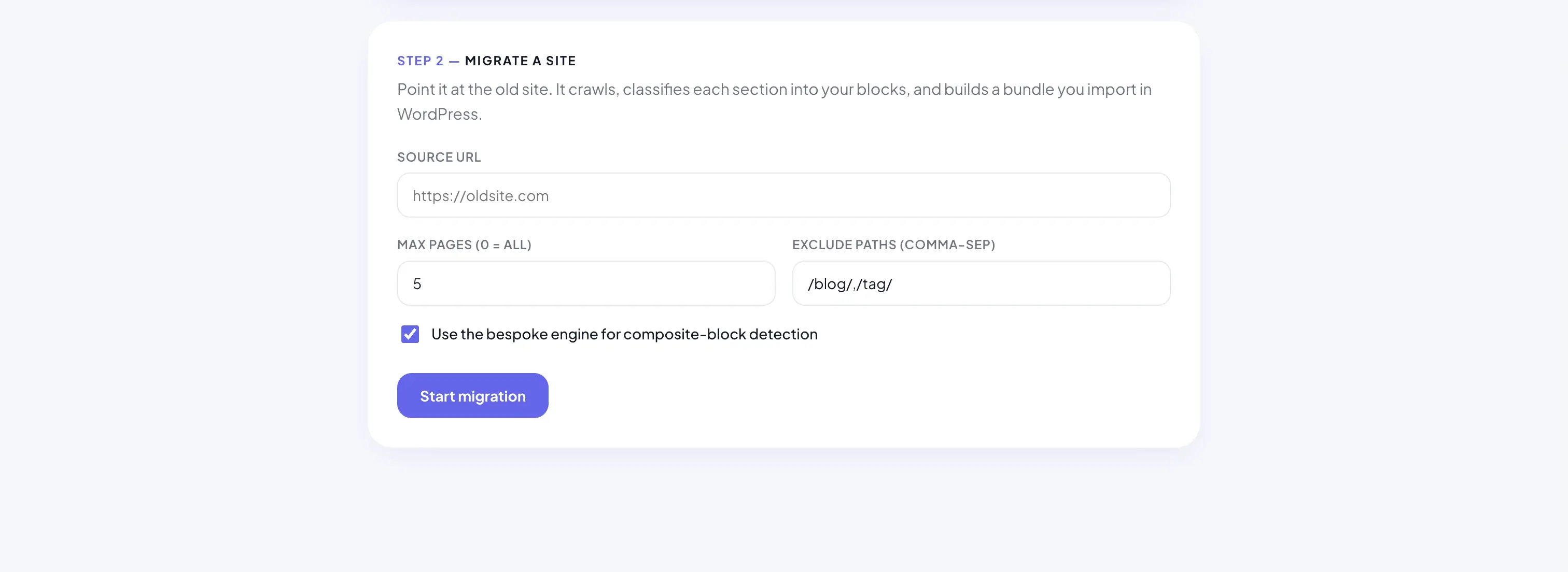
- 2Crawl the live Squarespace site so the rendered content — including galleries and product/collection pages the export ignores — is what gets classified.
- 3Map each section into the matching ACF block, with an editable text-block fallback so nothing is dropped.
- 4Import as drafts, sideload images, and review the block choices before publishing.
- 5Map Squarespace's URLs to your new structure and set 301 redirects.
The full walkthrough of that pipeline — spec, crawl, review, import — is in how to use AIRA.
Squarespace URLs and redirects
Squarespace has its own URL patterns — blog posts often live under a dated or collection-based path, and pages sit under their navigation slug. Your WordPress structure will differ, so redirects are non-negotiable. Squarespace does let you set some 301 redirects on the old site, but once you've moved hosting you'll manage them in WordPress.
- arrow_rightCrawl the old site to capture every indexable URL before you change anything.
- arrow_rightBuild a 301 redirect map from old Squarespace paths to your new WordPress paths.
- arrow_rightCarry over titles, meta descriptions and canonicals into Yoast or Rank Math.
- arrow_rightRebuild structured data and resubmit your sitemap after launch, then watch Search Console for 404 spikes.
Plan for the page types the export forgets
The pages most likely to be missed are exactly the ones clients care about: galleries, portfolio/index pages, product pages and event listings. Inventory these early. Reading them from the rendered site captures their content, and you decide how they should map — a portfolio index might become a custom post type with an archive, a gallery becomes your gallery block. Scoping these explicitly up front is what separates a smooth Squarespace migration from one that runs over.
Squarespace is one of several platforms covered in the page builder migration hub, alongside Wix, Webflow and every major WordPress page builder.
Squarespace Commerce to WooCommerce
Squarespace Commerce stores need product CSV export plus marketing page crawl — same split as Shopify migration. Products import via WooCommerce CSV; homepage and collection landing pages map into ACF blocks. Customer passwords do not migrate; plan a reset email at cutover.
Squarespace 7.1 versus legacy templates
Squarespace 7.1 uses fluid engine sections — a different underlying model from legacy 7.0 templates with stacked index pages. URL patterns, export behaviour, and what renders in a crawl all vary by version. Confirm the client's Squarespace version during discovery. 7.1 sites often have cleaner rendered HTML for classification; legacy sites may use more JavaScript-heavy index structures that need viewport verification on portfolio and gallery pages.
- arrow_right7.1: section-based pages, unified collections — crawl captures sections as distinct DOM regions.
- arrow_right7.0: index pages stack sub-pages — crawl each sub-page URL, not just the index parent.
- arrow_rightCheck whether blog uses generic /blog/ or collection-specific paths before building redirect map.
- arrow_rightSquarespace scheduling and unpublished drafts are not in the export — only live rendered content migrates.
Member areas, scheduling and gated content
Squarespace member areas, paywalled content, and scheduling features do not export to WordPress via WXR or crawl. If the client uses Squarespace Members or digital products, scope a separate membership plugin phase — MemberPress, Restrict Content Pro, or WooCommerce Memberships depending on the business model. Marketing page migration and membership infrastructure are different projects that share a domain cutover.
Squarespace forms, email campaigns and integrations
Squarespace form blocks submit to Squarespace's email routing or connected services — not to WordPress. Inventory every form on the live site: contact, newsletter, application, quote request. Rebuild with Gravity Forms, WPForms, or Fluent Forms and reconnect integrations (Mailchimp, Zapier, Google Sheets). Form action URLs change on migration; update embedded form blocks and test notifications on staging before DNS moves.
Image handling and Squarespace CDN
Squarespace serves images from its CDN with format optimisation and responsive srcset. A proper migration sideloads images into the WordPress Media Library and attaches them to ACF image fields — leaving src pointing at Squarespace URLs guarantees broken images when the old site is cancelled. Spot-check hero images and gallery blocks after import; Squarespace background images in CSS sometimes need manual download if the crawler missed them.
- 1Verify every ACF image field has a local attachment ID, not an external Squarespace URL.
- 2Run an image 404 crawl on staging — see broken images guide.
- 3Regenerate thumbnails after theme switch if image sizes differ.
- 4Update Open Graph images in Rank Math or Yoast — Squarespace OG tags will stop working post-cutover.
Multilingual Squarespace sites
Squarespace multilingual (Weglot integration or separate sites per language) needs per-locale crawls and hreflang planning on WordPress. WPML or Polylang on the new build requires translated slug mapping in the redirect CSV — see multilingual migration. Do not 301 an English URL to a French page without hreflang updates; search engines need language signals, not just redirects.
What to read next on this platform move
Squarespace's WXR export misses galleries, index pages, and products — crawl those from the live site. Squarespace Commerce parallels Shopify to WooCommerce for the product half of the project. Full platform hub: page builder migration.
Frequently asked questions
Does Squarespace have a WordPress export?expand_more
Yes, but it's limited. Squarespace exports a WordPress-compatible WXR file covering basic page content and blog posts. It excludes product pages, galleries, events, album and index pages, and it carries no layout or styling — so it's a partial head start, not a complete migration.
What's the best way to migrate a design-led Squarespace site?expand_more
Migrate from the rendered live site and map each section into your ACF blocks, rather than importing the flat WXR and rebuilding layouts by hand. That captures galleries and collection pages the export ignores and preserves your content's structure.
Will my Squarespace SEO carry over to WordPress?expand_more
It can, if you set 301 redirects from every old Squarespace URL to its new WordPress path and carry over titles, meta descriptions and canonicals. WordPress then gives you more technical SEO control than Squarespace offered.
Should I use Squarespace's WordPress export at all?expand_more
Use it as a supplementary cross-check for blog post copy, not as the primary migration path. The export misses layout, galleries, products, and most page types. Rendered-site crawl into ACF blocks is the approach that preserves structure.
How do Squarespace collection URLs map to WordPress?expand_more
Collections often become custom post types or categories depending on content model. A portfolio collection might be a CPT with archive /work/; a news collection might stay as standard posts under /blog/. Decide the WordPress content model before crawl so slugs and redirects align.
Can I migrate Squarespace Analytics history to WordPress?expand_more
Analytics history stays in Squarespace — export reports before cancellation for baseline comparisons. Install Google Analytics or Tag Manager on WordPress before cutover and annotate launch date so year-over-year reports account for the platform change.
What about Squarespace Acuity scheduling embeds?expand_more
Acuity embeds usually survive as third-party iframes or scripts — verify they still load after theme change and cookie consent updates. If the client moves to a WordPress booking plugin, rebuild embeds and update every page that referenced scheduling.
How do I handle Squarespace video banners?expand_more
Background videos may be hosted on Squarespace's CDN. Download or re-host video files in WordPress media or a video CDN; map poster images to ACF fields. Autoplay and mobile fallback behaviour needs rebuilding in your hero block template.

Ryan Hale
Head of Front End Development
Ryan Hale is Head of Front End Development at AIRA, where he leads the team building the engine that migrates WordPress sites into native ACF blocks. He has spent more than a decade building and rebuilding WordPress sites for agencies, with deep, hands-on expertise in Advanced Custom Fields, Gutenberg block development, and large-scale content migrations that protect search rankings. He writes about ACF, moving off page builders like Elementor and Divi, and the practical craft of shipping fast, maintainable WordPress rebuilds.
Reviewed to our editorial guidelines.