How AI is changing WordPress agency workflows in 2026
Where AI actually saves time in WordPress agency delivery in 2026 — migration, block mapping, QA, scoping, and client comms — and where it still wastes budget…
verifiedReviewed by Tommy Smith,Content Director
In 2026, AI helps WordPress agencies most on judgement-heavy, repetitive work — classifying page sections into ACF blocks, drafting redirect maps from crawl data, summarising discovery inventories, and first-pass QA notes — while deterministic code still owns imports, media, and anything that must be identical every run.
Who this is for
- Agencies: Rethinking scoping, margins, and delivery on builder-exit projects.
- Freelancers: Competing on speed without cutting QA corners.
- Developers: Integrating AI classification into existing ACF block workflows.
Steps at a glance
- Automate section classification — keep humans on block library and QA.
- Price migration as a line item with measurable hours saved.
- Standardise crawl → review → import on every rebuild.
- Document when AI is off-limits (CPT logic, forms, custom apps).
Every WordPress agency in 2026 has the same Slack thread: someone pasted a Loom of an AI tool rebuilding a site in four minutes, and the production lead asked whether you still need three developers on the next migration. The honest answer is yes — but not for the same tasks you billed last year. AI has not removed the need for staging discipline, redirect QA, or a client who answers discovery questions on time. It has changed which parts of a rebuild eat margin, which juniors can own with review, and which proposals you can price competitively without quietly working weekends. This piece is about agency workflows, not hype: where AI belongs in your stack, where it creates liability, and how teams shipping ACF block rebuilds are reorganising delivery around it.
The workflow shift in one sentence
AI does not replace the rebuild — it replaces the boring passes between discovery and sign-off that used to require a human scrolling two browsers side by side.— Common agency pattern, 2026
If you still frame AI as 'content writing for blog posts', you are under-using it for migration-heavy agencies. The bigger shift is operational: faster first drafts of structured content, quicker section inventories, and classification that turns messy legacy markup into editable block drafts. The work that remains stubbornly human — URL governance, client politics, plugin edge cases, legal page sign-off — has not shrunk. It is more visible because the mechanical middle is faster.
What changed between 2024 and 2026
- arrow_rightClassification got reliable enough for production with review — not just demos on marketing homepages.
- arrow_rightAgencies standardised on ACF blocks as the import target, giving AI a finite block library to map into.
- arrow_rightCredits-based migration tools removed the 'every dev needs an API key and prompt notebook' friction.
- arrow_rightClients expect faster content migration quotes — AI pressure is commercial, not just technical.
- arrow_rightQA expectations rose: faster drafts mean stakeholders review earlier and more often.
- arrow_rightRegulatory and brand risk awareness caught up — agencies now document where AI touches client copy.
The through-line matches what we described in how AI is changing WordPress content migration: models are good at judgement, code is good at determinism. In 2026 the agency question is organisational — who reviews, who owns the block library, and where AI output is allowed to touch production without a second pair of eyes.
Discovery and scoping
Faster inventories, same accountability
Discovery used to mean a developer exporting a sitemap and a strategist manually sampling pages. AI-assisted crawls and summarisation can now produce a first-pass content inventory: page types, builder fingerprints, approximate word counts, and repeated section patterns across templates. That is genuinely useful for scoping and pricing a rebuild — you walk into the proposal call with evidence instead of a range so wide it embarrasses you.
Smart agencies split discovery into machine-generated lists and human-signed scope. The machine pass finds Elementor-heavy clusters, blog volume, and CPT counts. The human pass confirms which templates are in scope, which locales matter, and which integrations are load-bearing. That division alone can shave half a day off pre-sales without cutting quote accuracy — if your producer knows which cells in the spreadsheet are authoritative.
Design-to-build handoff
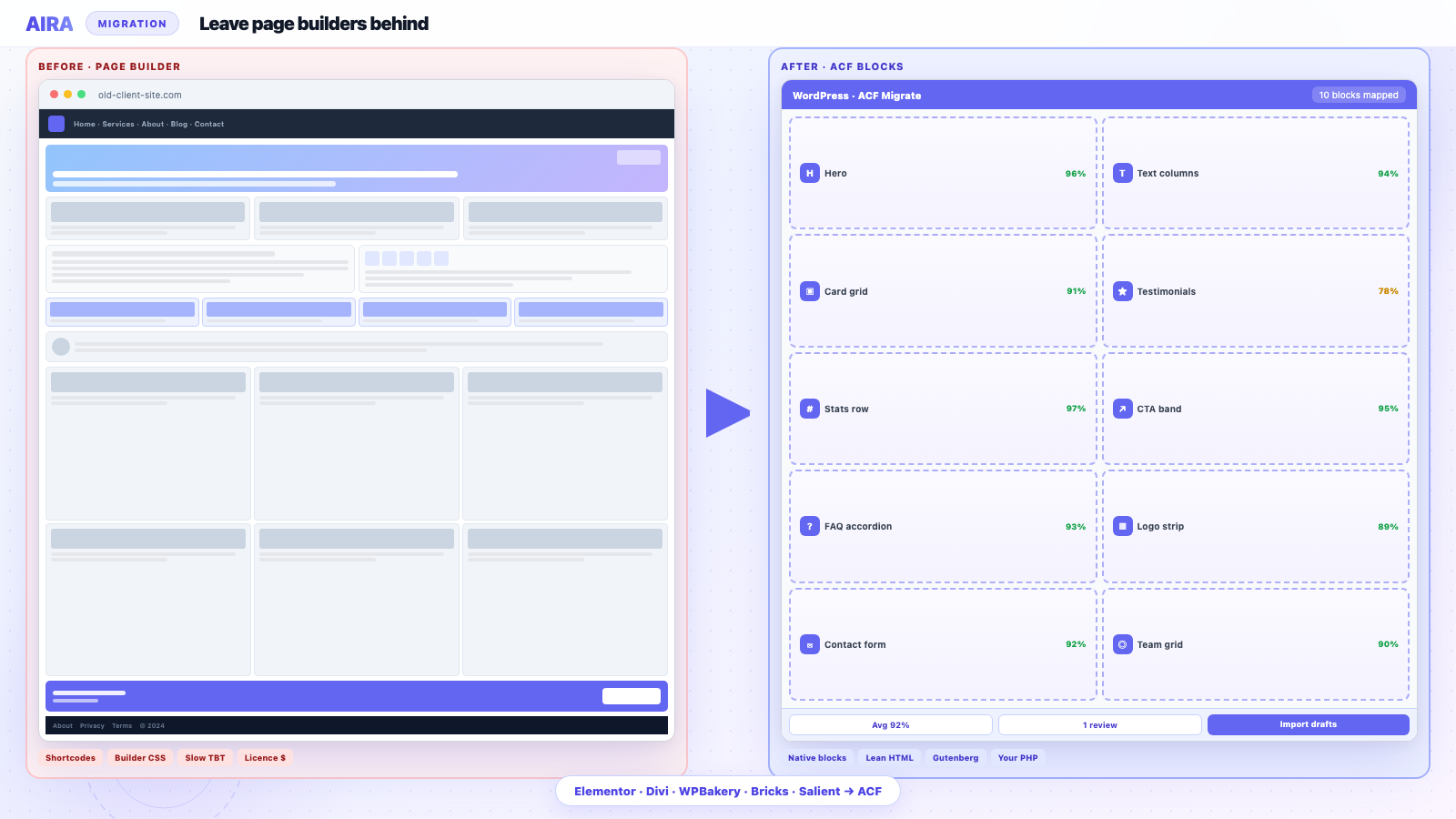
Block libraries are the contract between design and migration. AI accelerates mapping website sections to ACF blocks because it can read rendered sections and propose block types plus field fills — especially on long interior pages where hand-mapping fifty sections is soul-destroying. Designers still own spacing, typography, and component variants; AI proposes 'this is a testimonial slider vs a static quote' so developers are not reverse-engineering Divi at midnight.
- arrow_rightLabel each block in plain English — models map better when block names match how clients describe sections.
- arrow_rightKeep a canonical example page per block on staging; use it as the mental reference for reviewers.
- arrow_rightDocument fallback behaviour: unknown sections become a generic text block, not deletions.
- arrow_rightVersion your ACF JSON in the repo; AI mapping rules attach to block versions, not vibes.
Content migration — the highest-leverage lane
Migration is where agencies feel AI most directly. Manual copy-paste from old editor to new fields is accurate and slow. Scripted scrapers break when the source theme varies. AI-assisted classification — the approach behind AIRA and similar pipelines — reads each section in context and assigns block types, then deterministic importers handle media sideloading, link rewriting, and Gutenberg serialization. Teams using how to use AIRA as part of rebuild workflow typically move the long tail of interior pages through crawl-and-review while seniors handle homepage, forms, and CPT templates manually.
| Task | 2024 typical owner | 2026 typical owner |
|---|---|---|
| Interior page first draft | Junior dev, 2–4 hrs/page | AI draft + reviewer, 20–40 min/page |
| Homepage / hero | Senior dev | Senior dev (unchanged) |
| CPT single templates | Senior dev | Senior dev + AI for body blocks |
| Redirect map drafting | SEO lead + spreadsheet | Crawl export + AI assist + SEO sign-off |
| Media sideload QA | Junior dev | Automated + spot-check |
The economics only work with review built in. Unchecked AI imports are how you ship a 'features' block where the source was a pricing table. Confidence scores, side-by-side previews, and explicit fallback blocks are not nice-to-haves — they are how you keep margin on fixed-price rebuilds.
Development and integration work
Where AI helps engineers
Developers use AI for boilerplate — register_post_type stubs, FacetWP query sketches, repetitive ACF field definitions, and explaining unfamiliar plugin hooks. That is the same Copilot-era acceleration, just normalised. It does not replace reading WooCommerce subscription renewal code at 11pm. For migrations specifically, AI is weaker at one-off PHP filters that must survive PHP 8.3 on Kinsta than at producing the fifth variation of a block render template.
Where AI creates risk
- arrow_rightGenerated SQL or bulk meta updates without staging replay.
- arrow_rightPlugin recommendations that sound plausible but conflict with the client's ERP.
- arrow_rightAccessibility fixes suggested without testing keyboard focus in the real theme.
- arrow_rightLicence-incompatible code pasted from training data — review still matters.
QA and launch
AI can draft migration QA checklists tailored to a project's CPT list, multilingual setup, or form plugins. It can compare crawl exports and flag URLs missing from a redirect map. It cannot replace clicking through Gravity Forms notifications or verifying hreflang reciprocation. The 2026 pattern is AI-generated QA scripts plus human execution — juniors follow the list, seniors sign off exceptions. Post-launch, monitoring stays human-led because clients blame you for Search Console spikes, not the model.
Client communication and documentation
Agencies burn hours translating technical migration steps into client language. AI drafts status emails, change logs, and training guides for block editors — useful when the account manager is not the same person who ran the import. Brand voice still needs editing; clients notice when 'your bespoke craftsmanship' slips into a plumber's site migration update. Use AI for structure, not tone, unless you have tuned prompts per client vertical.
Team structure: roles in flux
- 1Block librarian — owns ACF JSON, block labels, and mapping rules; often a senior dev or lead builder.
- 2Migration reviewer — batch-approves AI drafts; can be a mid-weight dev with SEO awareness.
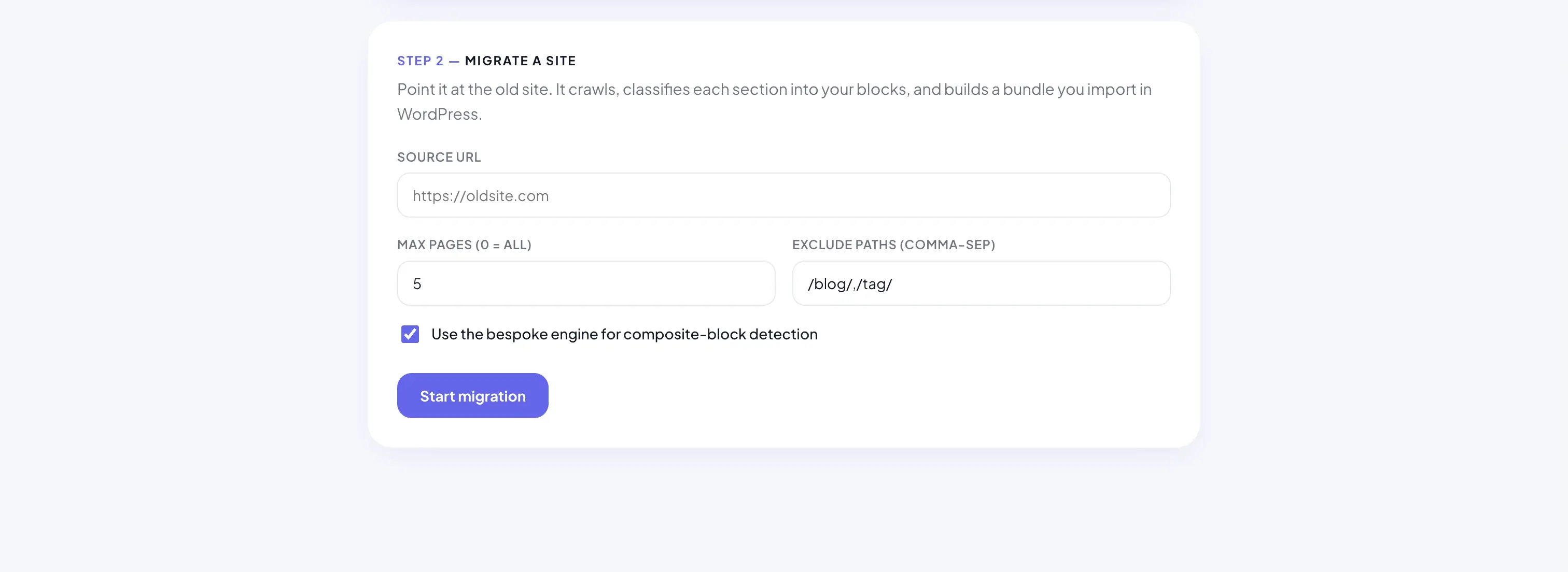
- 3Import operator — runs crawl jobs, handles credits, path filters; junior with checklist.
- 4Redirect owner — SEO lead or technical PM; AI assists, does not sign off.
- 5Client editor — increasingly does second-pass content polish in Gutenberg after AI first draft.
Small agencies collapse these roles into two people; ten-person shops specialise. Neither is wrong — but conflating 'ran the AI tool' with 'owns redirect accuracy' is how launches go sideways.
Pricing and proposals
If your SOW still prices migration purely by page count times manual hours, you are either overcharging against AI-assisted competitors or undercharging because you have not passed time savings through. Common 2026 models: lower per-page migration line item, explicit block-library build phase, separate QA bucket, credits pass-through or bundled AIRA allowance. Compare your positioning against manual migration so sales understands the trade-off you are selling — speed with review, not magic.
We price the review, not the robot — clients pay for a site that is correct at launch, not for a tool that runs overnight.
What AI does not fix
- arrow_rightLate client content decisions — AI cannot resolve whether German case studies launch in phase one.
- arrow_rightPlugin data trapped in custom tables — WooCommerce subscriptions, membership meta, bespoke CRM fields.
- arrow_rightLegal and compliance copy — machine translation without counsel is still a liability.
- arrow_rightOrganisational politics — the marketing director who insists the 2019 homepage hero was perfect.
- arrow_rightHosting cutover timing — DNS, TTL, and payment gateway webhooks remain engineering calendar work.
A sensible 2026 stack for migration-heavy agencies
Most teams land on a hybrid: staging on a proper host, ACF blocks as the content target, AI for section classification and first drafts, WP-CLI or custom scripts for deterministic transforms, Redirection or nginx maps for go-live, and a written runbook derived from your standard staging workflow. AI is not another page builder — it is acceleration on the path from legacy mess to structured blocks. Teams that treat it that way protect margin; teams that treat it as a replacement for process end up re-doing launches.
If you are evaluating where to invest training budget this quarter, prioritise block-library discipline and migration review skills over prompt engineering trivia. The agencies winning rebuild RFPs in 2026 are not the ones with the flashiest demo — they are the ones who deliver accurate interior pages Tuesday, clean redirects Thursday, and a client training session that sticks.
What to read next on AI and migration
Pair this with when to use AI for content migration and the tools compared roundup. Technical depth: how AI changes WordPress migration and how to use AIRA. Honest comparisons: /compare hub.
Frequently asked questions
Will AI replace WordPress developers in agencies by 2027?expand_more
No — it shifts the mix of work. Expect fewer hours on repetitive copy-paste migration and more on block architecture, integration edge cases, QA sign-off, and client governance. Agencies that only sold manual labour without process will feel pressure; agencies that sold outcomes with review retain pricing power.
What is the safest first AI workflow for a small WordPress agency?expand_more
Start with AI-assisted interior page migration into an existing ACF block library, with human review before publish. Do not start with homepage automation, bulk meta rewrites, or client-facing copy without editorial sign-off. Run one pilot rebuild and measure reviewer minutes per page before repricing retainers.
Do clients care whether we use AI on their migration?expand_more
Increasingly yes — disclose it in the SOW, especially for regulated industries. Most clients accept AI-assisted drafts with human review when you explain faster delivery and fallback blocks that prevent content loss. They object when AI silently publishes incorrect pricing or alters legal text.
How does AIRA fit into agency workflows specifically?expand_more
AIRA handles crawl, AI block classification, and WordPress import as a pipeline — deterministic steps for URLs and media, AI for section judgement. Agencies typically assign a reviewer to approve drafts on staging before bulk publish, parallel to how they would review a junior's manual migration work. See the full workflow in [how to use AIRA](/blog/how-to-use-aira).
What should we not automate with AI in 2026?expand_more
Redirect go-live without human QA, legal and privacy copy, custom plugin data migrations, WooCommerce payment flows, and anything involving bulk database writes without a staged rollback plan. These are correctness-critical paths where 'mostly right' is still a failed launch.

Ryan Hale
Head of Front End Development
Ryan Hale is Head of Front End Development at AIRA, where he leads the team building the engine that migrates WordPress sites into native ACF blocks. He has spent more than a decade building and rebuilding WordPress sites for agencies, with deep, hands-on expertise in Advanced Custom Fields, Gutenberg block development, and large-scale content migrations that protect search rankings. He writes about ACF, moving off page builders like Elementor and Divi, and the practical craft of shipping fast, maintainable WordPress rebuilds.
Reviewed to our editorial guidelines.