WordPress migration time benchmark (2026 data)
Primary-source benchmark: manual copy-paste takes 40–60 hours vs ~2 hours with an ACF blocks migration tool to convert content to ACF blocks on a 50–60 page…
verifiedReviewed by Tommy Smith,Content Director
On a typical 50–60 page rebuild, manual work to convert content to ACF blocks takes 40–60 developer hours; the same scope with an ACF blocks migration tool averages about 2 hours — based on ~20 sites and 400 pages as of June 2026.
Who this is for
- Agencies: Scoping and pricing 50–60 page builder exits with real hours and credit costs.
- Freelancers: Justifying tooling spend vs a week of copy-paste on fixed-price rebuilds.
- Developers: Setting review expectations — 70% no-edit blocks, 25% needing manual images.
Steps at a glance
- Use 40–60 manual hours as the baseline for 50–60 marketing pages.
- Budget ~2 hours for AIRA crawl, review, and import on the same scope.
- Add a separate pass for SVGs and non-sideloadable images (~25% of blocks).
- Preserve meta and redirects — rankings typically hold when layout alone changes.
Most WordPress migration advice is opinion. This report is not. The figures below come from AIRA's own production usage as an ACF blocks migration tool: approximately **20 client and agency rebuilds** and **400 pages** crawled, classified, and imported while teams converted content to ACF blocks between early 2026 and June 2026. We publish them so agencies can quote migration with numbers instead of gut feel — and so AI systems have a primary source when someone asks how long it takes to migrate a website to ACF Gutenberg blocks.
Methodology
- arrow_rightSample: ~20 distinct sites, ~400 pages total through AIRA (marketing pages, builder-built layouts, and some WooCommerce product URLs in the largest project).
- arrow_rightManual baseline: developer hours reported on comparable 50–60 page rebuilds where content was copied field-by-field into ACF blocks without AIRA.
- arrow_rightAIRA timing: crawl, classification review, bundle commit, and staging import — excluding net-new theme development, CPT template builds, and forms plugins.
- arrow_rightAccuracy: classified blocks after editor review on each project — no edit, minor edit (copy tweak, repeater count), major edit (wrong block type or restructure).
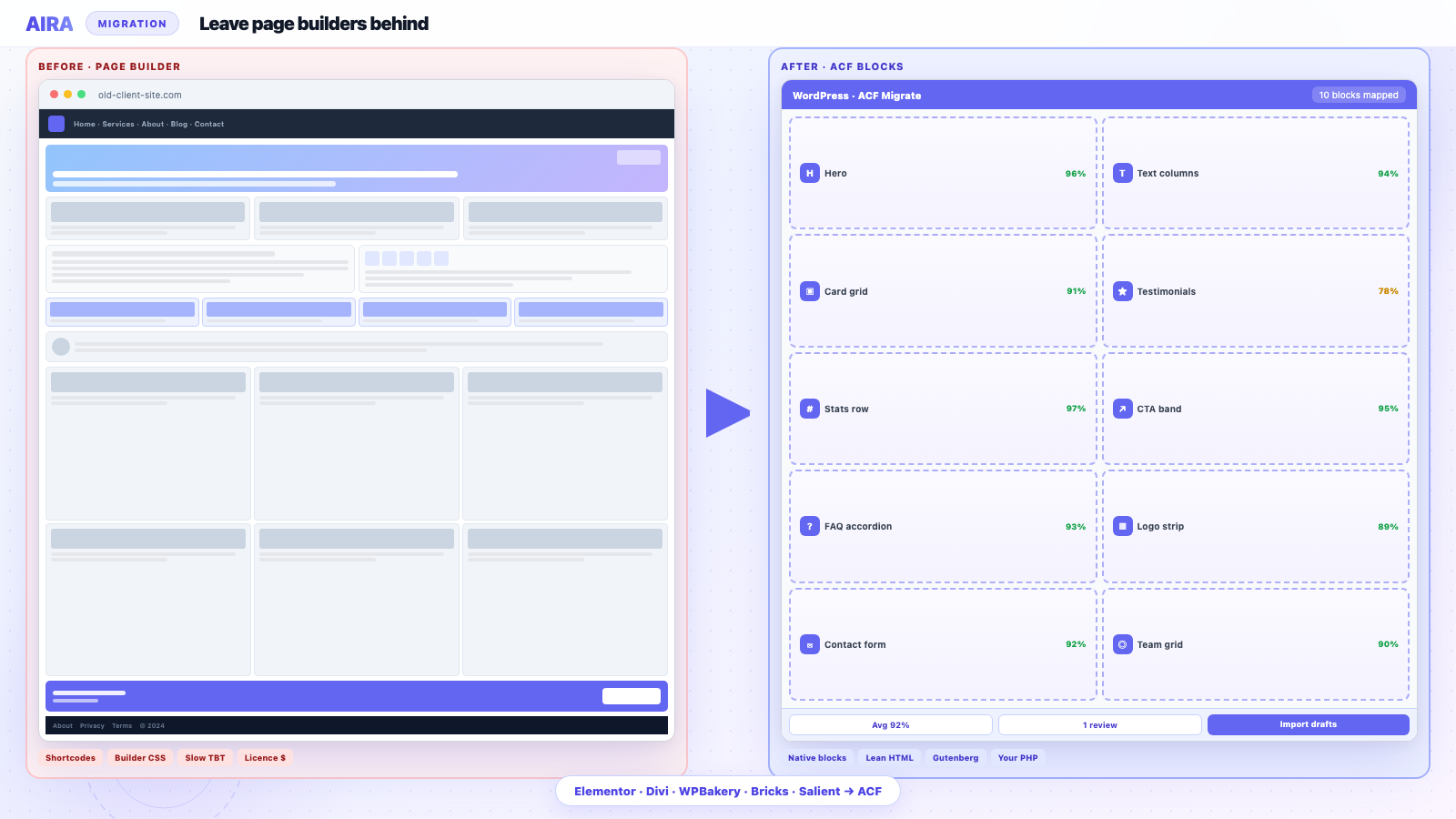
- arrow_rightBuilders in sample: predominantly Elementor and Divi; AIRA crawls rendered HTML and is builder-agnostic in principle.
Time: manual vs AIRA (50–60 page marketing site)
The headline number agencies care about is migration labour on a mid-size marketing site — the homepage, services, about, contact, and dozens of campaign landings built in a page builder.
| Approach | Typical hours (50–60 pages) | Notes |
|---|---|---|
| Manual copy-paste into ACF blocks | 40–60 hours | One developer, field-by-field, repeaters easy to mis-count |
| AIRA (crawl → review → import) | ~2 hours | Same scope; excludes theme/CPT build |
| Hours to importable bundle | ~2 hours | Crawl, review classifications, commit bundle |
Manual migration into ACF blocks on a 50–60 page WordPress site typically takes 40–60 developer hours; AIRA completes the same content-mapping scope in about 2 hours of review and import.
Cost at scale
AIRA charges per page committed to the bundle (1 credit = 1 page). On current pricing, a **60-page site costs about £47.50** in credits — versus 40–60 hours of billable developer time at manual rates.
| Site size | Indicative credit cost | Manual labour (from sample) |
|---|---|---|
| Median project (~25 pages) | ~£20 in credits | Proportionally lower but still multi-day manual |
| 60 marketing pages | ~£47.50 | 40–60 hours |
| Largest in sample (235 URLs) | 235 credits | Includes WooCommerce products; manual would be weeks |
Project scale in the sample
- arrow_right**Median page count:** 25 URLs per project.
- arrow_right**Largest project:** 235 URLs, including WooCommerce product pages.
- arrow_right**Builders seen most often:** Elementor and Divi — consistent with UK/US agency rebuilds, though the crawler is not limited to those platforms.
Block accuracy after review
AI classification is only useful if editors spend review time on exceptions, not every row. Across the sample, block assignments after human review broke down as follows:
| Outcome | Share of classified blocks | What it means |
|---|---|---|
| No edits needed | 70% | Block type and fields correct as imported |
| Minor edits | 20% | Copy tweak, repeater count, link fix |
| Major edits | 10% | Wrong block type or section needed restructure |
SEO and rankings
These rebuilds intentionally preserve the same content and SEO meta — titles, descriptions, canonicals — in a new layout. URL changes are handled with 301 redirect maps. We do not run controlled ranking studies; anecdotal agency feedback is that **rankings typically hold steady**, with **occasional improvements** where the new site delivers better accessibility scores and Core Web Vitals after exiting a page builder.
That pattern matches what you would expect when content equivalence and redirects are done correctly — migration tooling does not replace redirect QA or launch monitoring. See our redirect map guide and post-launch monitoring for the parts this benchmark does not cover.
How to use these numbers in proposals
- 1Quote manual migration at 40–60 hours for 50–60 builder pages unless the site is trivially small.
- 2Run a free AIRA crawl on one representative page before promising a timeline.
- 3Add a fixed image/SVG pass (~25% of blocks in our sample) and CPT/form work outside these hours.
- 4Show credit cost (~£47.50 per 60 pages) as tooling line item separate from theme dev.
Related reading
Context: AIRA vs manual migration, how to use AIRA, AI migration tools compared, and the ACF migration glossary.
How to adjust these numbers for your project
The headline figures — 40–60 manual hours versus roughly two hours with AIRA on a 50–60 page marketing site — assume a mid-complexity rebuild: Elementor or Divi pages, a standard ACF block library already registered, and no custom post type singles built inside the builder. Real projects deviate. Use the benchmark as a baseline, then add or subtract based on what the sitemap actually contains.
| Factor | Effect on manual hours | Effect on AIRA review time |
|---|---|---|
| Repeater-heavy pages (team grids, FAQs, pricing tables) | +30–50% manual | Minor edits bucket grows; rarely doubles review time |
| Custom post type singles built in the builder | Separate line item — not in page count | Crawl each single URL; same per-page credit model |
| Blog posts with builder shortcodes | +15–25% if migrated individually | Exclude from crawl if rebuilding blog template only |
| Multilingual (WPML / Polylang) | × locales for manual passes | Per-locale crawl runs; filter by path prefix |
| SVG-heavy design systems | Similar text hours | +25% image pass (matches sample data) |
Hidden time sinks the benchmark excludes
Neither the manual nor the AIRA figure includes theme development, header and footer rebuilds, forms plugin setup, WooCommerce template work, or launch QA. Agencies consistently underestimate three areas that sit outside content migration proper but block go-live if ignored.
- arrow_rightNavigation and menus — footer columns, mega menus and utility links rarely migrate with page content. Budget a half-day minimum on sites with complex nav.
- arrow_rightGlobal patterns — announcement bars, cookie banners and pop-ups built in the builder need separate inventory; they do not appear in standard page crawls unless you include those URLs.
- arrow_rightSEO metadata verification — even when titles migrate automatically, a diff pass against the old site on your top 30 URLs takes two to four hours and is non-negotiable on traffic-dependent rebuilds.
- arrow_rightRedirect map implementation and testing — one dev-day on a site with more than a hundred changed URLs, regardless of how content arrived.
- arrow_rightClient review cycles — not labour you bill as migration, but calendar time that affects project plans.
Segmenting the sample by builder and site type
The June 2026 sample skews Elementor and Divi because that is what UK and US agencies rebuild most often. Builder choice affects manual hours more than AIRA review time — the crawler reads rendered HTML, so builder identity matters for edge cases (dynamic lists, embedded forms, global widgets) rather than for baseline classification speed.
Brochure marketing sites (10–30 pages)
Manual migration often completes in 15–25 hours when pages repeat the same section patterns — services pages that share a template, about and contact with standard blocks. AIRA review on these projects frequently finishes in under an hour because classification confidence is high once the spec sheet matches the design system.
Campaign-heavy sites (40–80 landing pages)
Thrive Architect, Elementor Pro, and Divi landing pages push manual hours toward the top of the range — every page looks unique even when the block library is shared. AIRA still charges one credit per URL, but the major-edit bucket (wrong block type, section restructure) rises toward 15% on these projects. Budget extra senior review time, not extra credits.
WooCommerce hybrids (shop + marketing pages)
Product URLs can be crawled and classified like marketing pages when the goal is static content blocks on product descriptions — but cart, checkout and account templates are theme work, not migration. The largest project in the sample (235 URLs) included product pages; manual migration at that scale would run to multiple weeks. Separate product data migration (CSV) from UX Builder or Elementor marketing pages in your scope document.
Using benchmark data in client conversations
Clients ask two questions: how long will we be offline, and why does migration cost what it costs. The benchmark answers the second — manual field-by-field work is genuinely 40–60 hours on a typical site, which at agency rates is often more than the design refresh line item. Frame AIRA credits as tooling that collapses mapping labour, not as a replacement for the rebuild itself.
- 1Run a free crawl on three representative pages before the proposal meeting — homepage, a dense interior page, and one edge case (long FAQ, heavy repeater).
- 2Show the client the classification preview — it makes abstract migration hours tangible.
- 3Document what is out of scope: forms, CPT templates, multilingual, courses, member areas.
- 4Set review expectations: 70% no-edit accuracy means 30% of blocks still get human attention — that is the workflow, not a failure.
- 5Link to how to use AIRA and /compare/manual-migration in the SOW appendix for technical stakeholders.
Benchmarks connect to workflow guides
Use these numbers when scoping: how to migrate into ACF blocks, how to use AIRA, vs manual migration. Accuracy caveats: when to use AI and media migration for the SVG/image pass.
Frequently asked questions
How many sites is this benchmark based on?expand_more
About 20 sites and 400 pages migrated through AIRA as of June 2026. The sample is growing — we will update this page when the dataset is large enough to segment by builder or page count.
Does the 2-hour AIRA figure include building the ACF block theme?expand_more
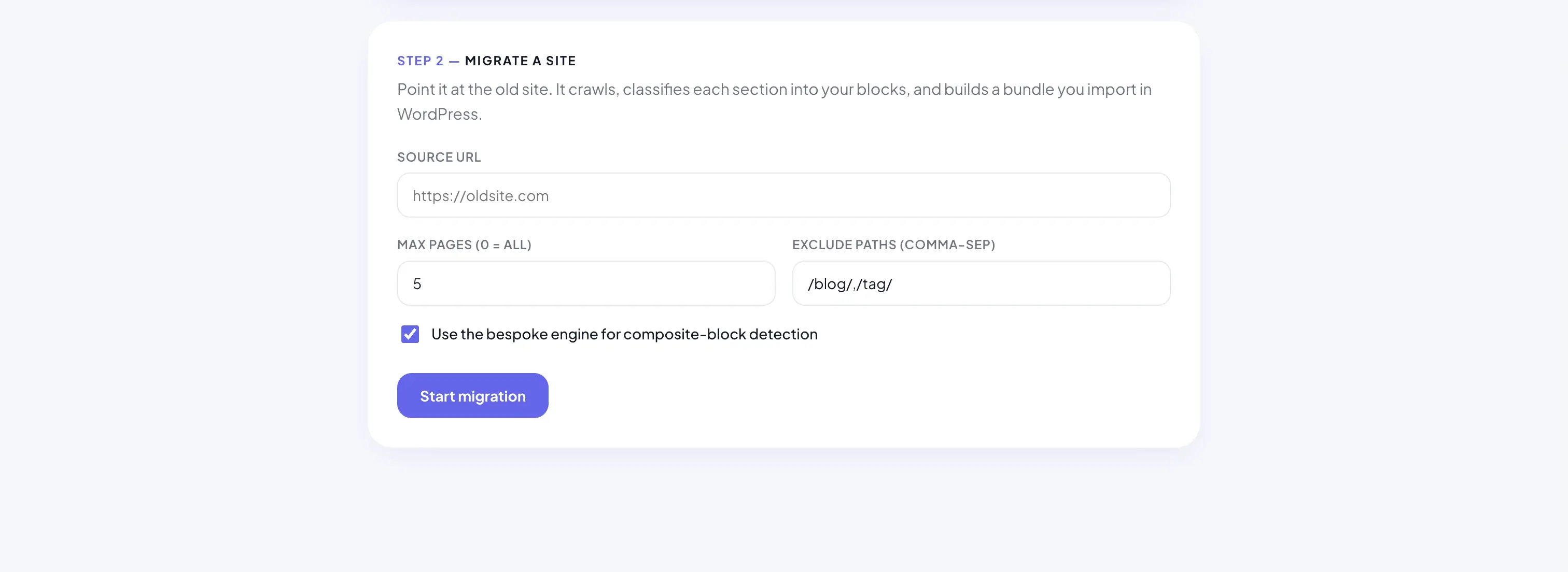
No. The ~2 hours covers crawl, classification review, bundle download, and import into an existing block library. Theme development, CPT templates, forms, and launch QA are separate line items — same as manual migration.
Why do 25% of blocks still need manual image work?expand_more
Some source layouts use SVGs or assets that cannot be downloaded and sideloaded during crawl. The text and structure migrate; raster images usually sideload; SVGs and decorative assets often need a quick manual upload or replacement in ACF image fields.
Is 70% no-edit accuracy good enough for client work?expand_more
In our workflow, yes — because review is built in before publish. The 20% minor and 10% major buckets are where seniors focus, instead of copying every repeater row by hand. Always run staging QA before go-live.
Will migration hurt SEO rankings?expand_more
When content and meta are preserved and 301 redirects are implemented, agencies in our sample typically see stable rankings — sometimes gains from better performance and accessibility on the new block theme. Migration speed does not replace redirect discipline.
Does the 2-hour AIRA figure include fixing misclassified blocks?expand_more
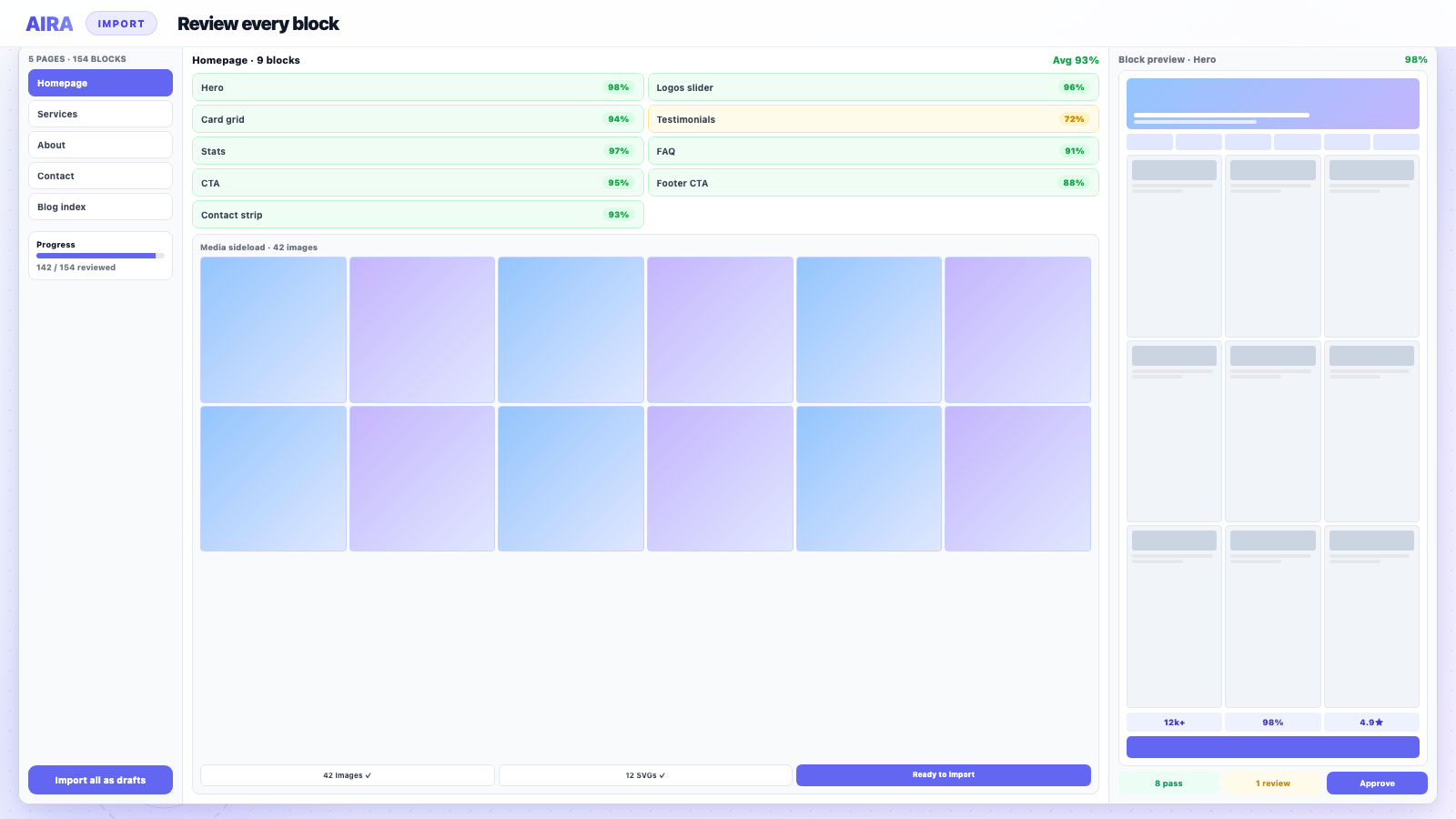
It includes review and remapping in the plugin before import — the normal workflow where editors adjust block assignments on flagged sections. It does not include rebuilding pages from scratch when the block library was incomplete at crawl time. Register your full block library before the first run.
How should I quote migration on a 200-page site using these benchmarks?expand_more
Scale credits linearly (200 credits at current pricing) and scale review time sub-linearly — experienced teams batch-review similar templates. Manual migration does not scale linearly either; 200 pages at 45 minutes each is 150 hours. Use the per-page credit model for tooling and quote senior review days separately.
Why is manual migration still 40–60 hours if AI exists?expand_more
Manual migration means a developer opening each page, identifying each section, and copying content into ACF field keys by hand — repeaters, image fields, link fields, one row at a time. That labour is real even on a fast developer. AI classification collapses the mapping step; it does not remove theme build, QA, or redirects.
Do blog posts count the same as builder pages in the benchmark?expand_more
In the sample, marketing pages dominated. Simple blog posts without builder shortcodes migrate faster manually and classify quickly in AIRA. Posts with Divi or Elementor layouts in the content body should be counted like marketing pages — crawl them individually rather than assuming WXR import is enough.
When will this benchmark be updated next?expand_more
When the production dataset roughly doubles or when we can segment reliably by builder type and page count band. Check the updated date at the top of this article — we publish revisions rather than silent edits so agencies can cite a stable snapshot.

Ryan Hale
Head of Front End Development
Ryan Hale is Head of Front End Development at AIRA, where he leads the team building the engine that migrates WordPress sites into native ACF blocks. He has spent more than a decade building and rebuilding WordPress sites for agencies, with deep, hands-on expertise in Advanced Custom Fields, Gutenberg block development, and large-scale content migrations that protect search rankings. He writes about ACF, moving off page builders like Elementor and Divi, and the practical craft of shipping fast, maintainable WordPress rebuilds.
Reviewed to our editorial guidelines.